AI Agent Bot Detection Fails 81% of the Time
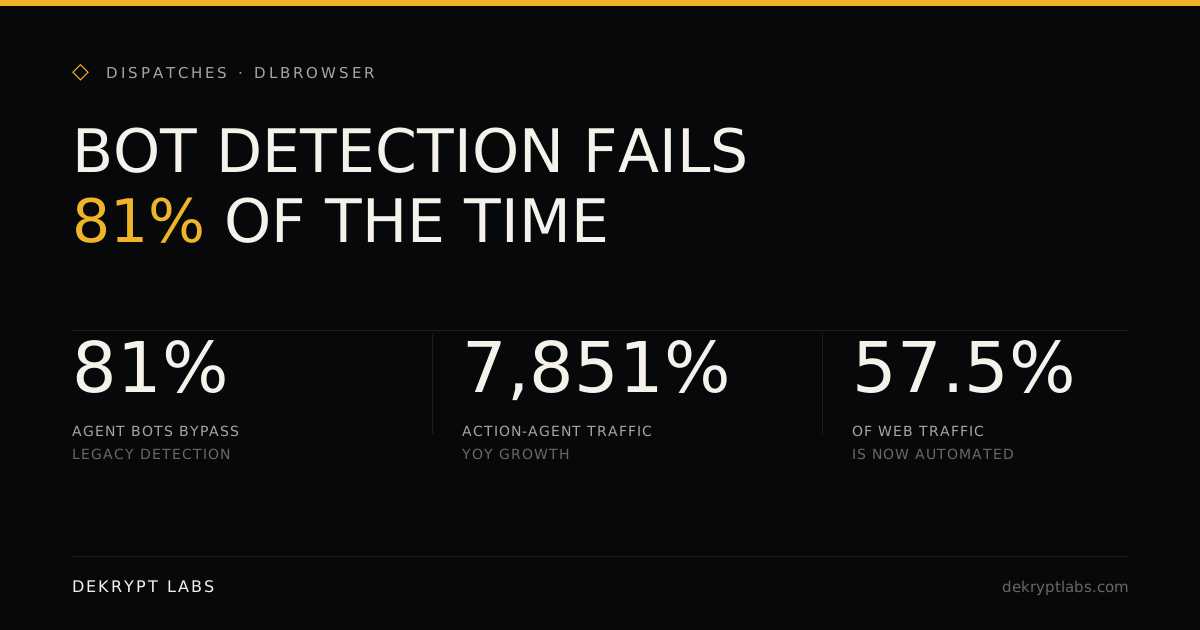
81% of AI-agent-based bots slipped past legacy bot detection platforms in production tests run by anti-fraud vendor cside. That's not a gap in one vendor's product — it's what happens when AI agent bot detection was built to catch scrapers, and the thing showing up now is a browser that clicks, types, and fills out forms like a person.
The short version
- Internal testing by cside found that 81% of AI-agent-based bots bypassed legacy bot detection platforms when run against real production defenses (cside).
- Agent traffic that takes action — clicking links, filling forms — grew 7,851% year over year, according to HUMAN Security's 2026 State of AI Traffic & Cyberthreat Benchmark Report (Fortune).
- Plain scraper traffic grew a comparatively modest 597% over the same period — the growth is concentrated in agents that behave like users, not crawlers that just fetch pages.
- Cloudflare Radar clocked automated requests at 57.5% of all HTTP traffic to web content in June 2026, versus 42.5% from humans — the first time machines outnumbered people on the open web (Tech Times).
- Detection systems are also blocking real people: one anti-detection vendor's review put some platforms' false-positive rate at 0.75%, 75 times the 0.01% they call the workable ceiling (Notte Labs).
Why Do Legacy Systems Miss AI Agents at This Rate?
Most bot detection was tuned against scrapers: scripts that hit the same endpoint thousands of times a minute with no mouse movement, no scroll, no delay. An agent driving a real browser — Playwright, Puppeteer, Chrome via CDP, or a purpose-built agent runtime — moves the mouse, waits, scrolls, and pauses between actions because that's what its underlying model was trained to imitate. The signal detection engines built for the old shape of automation doesn't fire on the new one.
cside's own research names the agents showing up in this traffic: OpenAI's Operator, Claude for Chrome, and browser frameworks like Playwright, Puppeteer, and Selenium, often only distinguishable from a human by combining several weak signals rather than any single tell (cside). Cloudflare's Matthew Prince said the crossover to majority-machine traffic wasn't supposed to arrive until 2027 by his own estimate three months earlier — "Welp, that happened faster than I predicted" (Tech Times).
Is the Problem Growth, or the Kind of Traffic That's Growing?
Both, but the mix matters more than the total. HUMAN Security's report splits AI-driven traffic into categories, and training crawlers — the GPTBot-style scripts that just read pages — still make up 67.5% of it, a share the report notes is shrinking. The fast-growing piece is agents that act: 7,851% growth in traffic that clicks, types, and submits, against 597% for plain scraping (Fortune).
| Traffic type | YoY growth (2026) |
|---|---|
| Agents that click/fill forms | 7,851% |
| Scraper traffic | 597% |
| Bots' overall share of HTTP traffic | 57.5% of total (June 2026) |
That split explains why blocklists built around known crawler user-agents — the GPTBot/CCBot/ClaudeBot approach most sites still lean on — don't touch this problem. A blocklist stops a script that announces itself. It does nothing against a browser that looks, in every log line, like a person clicking through a checkout flow.
What Happens When Detection Blocks the Wrong Traffic?
It costs real conversions, not just security posture. Notte Labs' review found some bot-management platforms running false-positive rates near 0.75% against an "ideal" of 0.01% — 75 times higher, meaning real customers get challenged or blocked as often as sophisticated bots get through (Notte Labs). DataDome's own case data shows the fix is tractable: its Device Check feature cut false positives 80% for one luxury retail brand, without loosening the rules on actual bots (same source).
The businesses adjusting fastest aren't trying to block agents outright — they're building lanes for the legitimate ones. Stripe, Visa, Ramp, Mercury, DoorDash, and Coinbase have all shipped agent-facing infrastructure this year rather than betting a wall will hold (Fortune). The sites still relying on 2023-era bot rules are the ones both losing to the 81% bypass rate and turning away real customers in the same breath.
This is the exact fork DLBrowser was built for: reaching pages reliably without tripping the defenses meant for the old kind of bot, on the side of the business that needs the data, not the side hiding a checkout form behind a false positive.
None of this settles into a stable equilibrium anytime soon. Detection vendors will retrain against agent behavior, agents will keep looking more human, and the traffic mix will keep shifting before either side calls it solved. The number worth tracking isn't 81% — it's whether that figure moves toward 50 or toward 95 by the time HUMAN Security or Cloudflare Radar publish their next count. Read more on how this connects to the wider data-access shift at Dekrypt Labs Dispatches and the underlying research at Dekrypt Labs Research.
Frequently Asked Questions
What percentage of AI agents bypass bot detection? Anti-fraud vendor cside's internal production tests found 81% of AI-agent-based bots bypassed legacy bot detection platforms, meaning most agent-driven traffic gets through defenses tuned for older, script-style scraping instead.
Why do bot detection systems struggle with AI agents specifically? Legacy systems look for scraper-shaped signals: no mouse movement, uniform timing, high request rates. Agents driving real browsers move, scroll, and pause like people, so detection needs to combine many weak signals instead of one clear tell.
How fast is AI agent traffic growing compared to plain scraping? Action-taking agent traffic (clicking, filling forms) grew 7,851% year over year in 2026 per HUMAN Security's benchmark report, versus 597% for traditional scraper traffic — the growth is concentrated in agents that behave like users.
Does blocking known crawlers like GPTBot stop AI agents from accessing a site? No. Crawler blocklists target scripts that announce themselves by user-agent. Browser-driven agents don't identify that way, which is why cside's tests still found four in five bypassing detection built around that older model.
Abhishek Gupta is Co-Founder at Dekrypt Labs, building DLBrowser — a stealth browser runtime for real-world data collection. dekryptlabs.com