AI Agent Reliability: Why 88% Never Reach Production
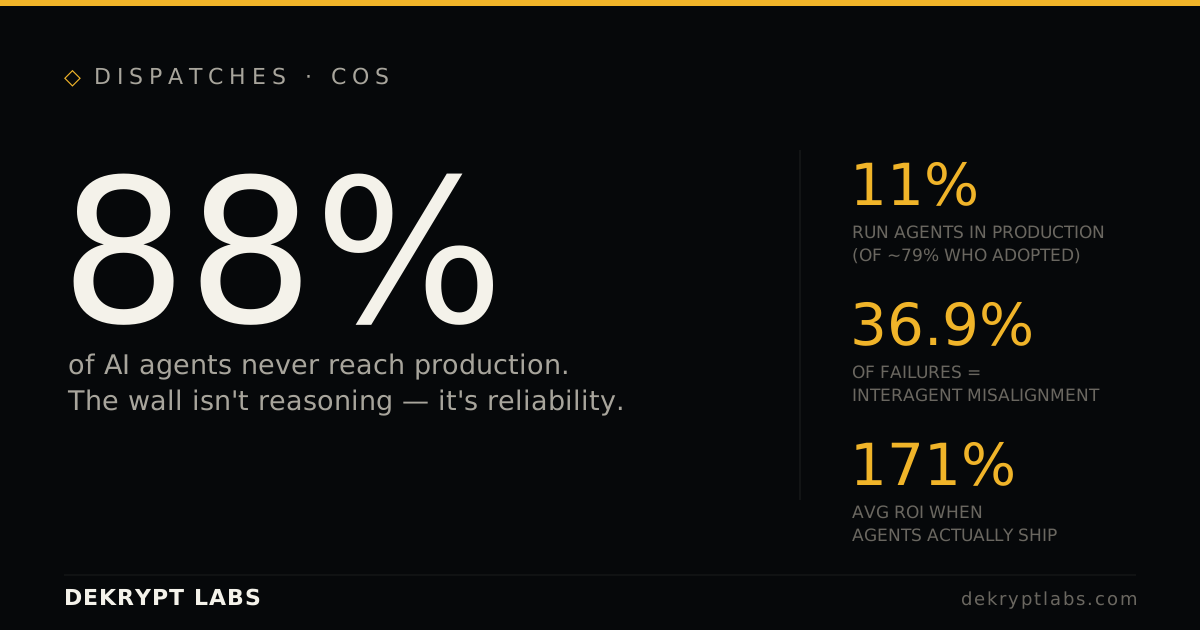
Almost four in five enterprises now run AI agents. Only one in nine has gotten one into production.
That gap is the whole story of 2026. AI agent reliability — not model intelligence — is now the thing standing between a slick demo and something a business actually depends on. The models got smart enough two years ago. The systems around them didn't.
The short version
- 88% of AI agents never reach production — fewer than 1 in 8 initiatives ship.
- ~79% of enterprises have adopted agents; only ~11% run them in production — a 68-point gap, the largest deployment backlog enterprise tech has seen.
- Interagent misalignment causes 36.9% of multi-agent failures: agents acting on inconsistent views of shared state.
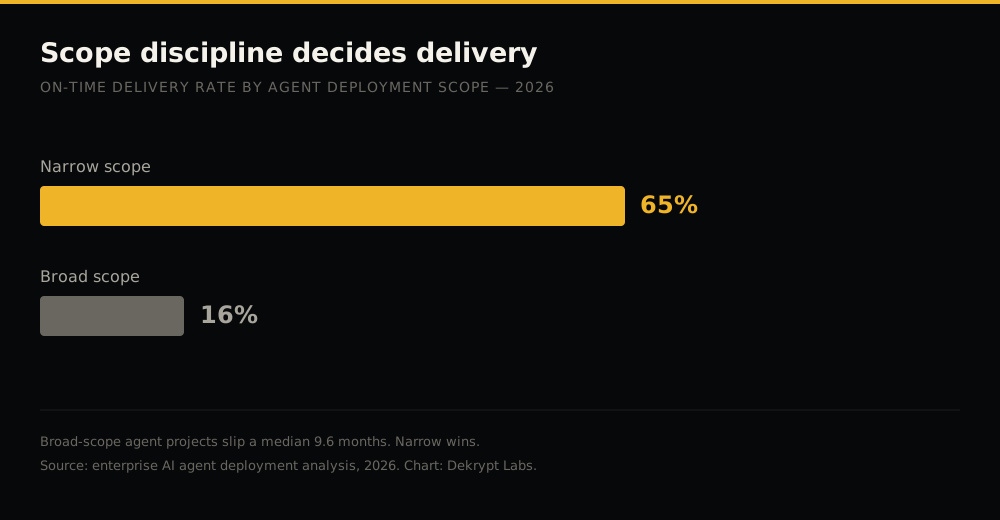
- Narrow-scope agent projects deliver on time 65% of the time; broad-scope ones, just 16% — with a median 9.6-month slip.
- The agents that do ship return an average 171% ROI. The prize is real. The wall is reliability.
The Gap Isn't Intelligence. It's Production.
The numbers are blunt. Across enterprise deployments in 2024 and 2025, 88% of AI agents never made it to production (Digital Applied).
Read that against adoption and it gets sharper. Nearly four in five companies have adopted agents in some form, yet only one in nine runs them live — a 68-percentage-point gap.
This is not a hype problem. The demand is genuine and the payoff is large. It's an engineering problem wearing a strategy costume, and most teams are still treating it as the latter.
Agents Don't Fail Because They Can't Reason
Here's the counterintuitive part. When researchers traced where multi-agent systems break, the top cause wasn't bad reasoning. It was interagent misalignment — 36.9% of all failures — where agents operate on inconsistent views of shared state (VentureBeat).
One agent thinks the invoice is paid. Another thinks it's pending. Both are "right" given what they can see. The system is wrong.
Memory is the other silent killer. Agents forget instructions mid-task, hallucinate prior context, or degrade over long sessions when memory is treated as an afterthought (mem0). None of that is a reasoning failure. It's a plumbing failure.
Why Do AI Agents Work in Demos but Fail in Production?
Because demos are built on clean inputs, cooperative users, and defined scenarios. Production has none of those — inputs are messy, users go off-script, and real scenarios diverge from the happy path within about 60 seconds.
That cliff is structural, not accidental. Every demo optimizes for the controlled case; production punishes exactly that optimization. An agent that looks brilliant on a stage can quietly stop being trusted the first week real people use it.
Reliability Is an Orchestration Problem
Scope makes the same point from a different angle. Narrow deployments hit their dates 65% of the time. Broad ones — the "let the agent do everything" pitch — land on time just 16% of the time, slipping a median 9.6 months. Adding capability without adding control makes things worse, not better.
What keeps an agent alive in production is the unglamorous layer underneath it: task breakdown, sequencing, shared state, memory, verification, and error handling. Long-running workflows have to survive crashes, preserve state, recover from failures, and stay consistent across tools and systems.
That orchestration layer is exactly what we build COS for — the capability operating system that lets agents plan, verify, remember, and improve across tasks, instead of each agent improvising in isolation. The reliability gap isn't closed by a smarter model. It's closed by giving agents one consistent view of the world and a system that remembers.
The teams winning in 2026 figured this out: they treat memory and orchestration as first-class infrastructure, not as glue code they'll write later. The 88% who don't reach production are mostly still writing the glue.
Frequently Asked Questions
Why do most AI agents fail to reach production? Roughly 88% of AI agents never ship, mostly due to reliability gaps rather than weak reasoning. Scope creep and data-quality issues drive 61% of failures, while inconsistent shared state and weak memory break agents once real, messy inputs replace clean demo conditions.
What causes multi-agent systems to fail? The leading cause is interagent misalignment — 36.9% of failures — where agents act on inconsistent views of shared state. Errors then propagate between agents. Without a shared memory and orchestration layer, small disagreements compound into system-level failures.
What is agent orchestration? Agent orchestration is the layer that manages how agents run: breaking work into tasks, sequencing them, coordinating communication, preserving state, and handling errors. It's what keeps multi-step, long-running agent workflows reliable in production rather than only in demos.
How do you make AI agents reliable in production? Treat memory and orchestration as first-class infrastructure, keep scope narrow, give every agent a consistent view of shared state, and add verification plus error recovery. Narrow-scope agents ship on time 65% of the time versus 16% for broad-scope builds.
Abhishek Gupta is Co-Founder at Dekrypt Labs, building COS — the capability operating system for reliable AI agents. See the full product line or read more dispatches. dekryptlabs.com