AI Data Licensing: What Publishers Actually Charge
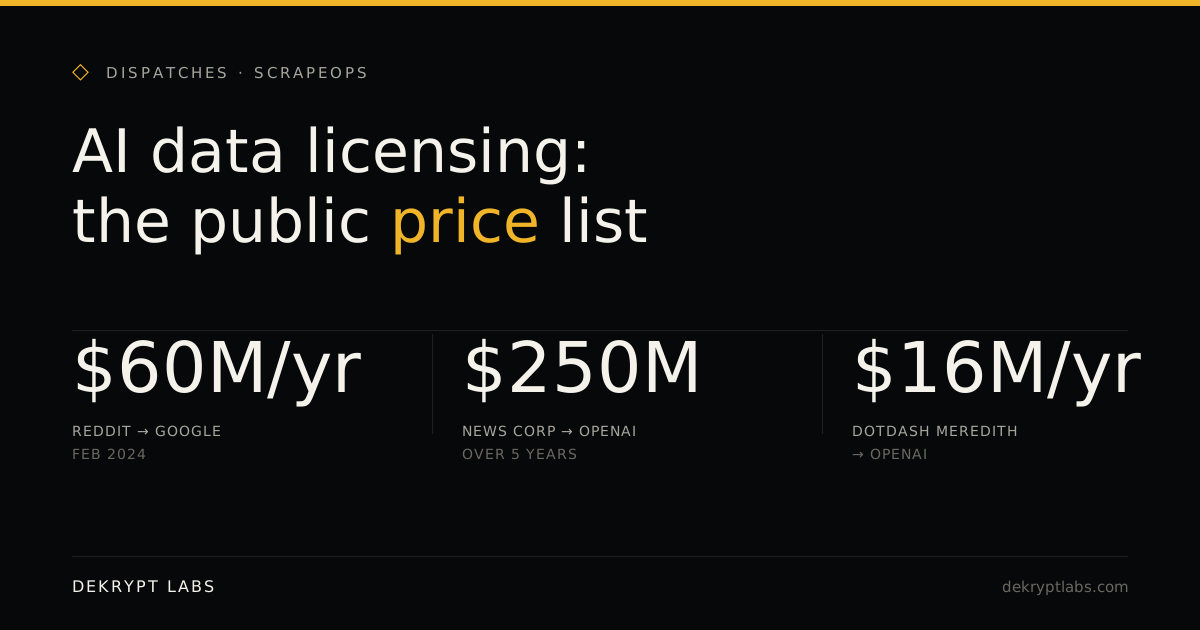
Reddit charges Google roughly $60 million a year for its data. That number surfaced in Reddit's February 2024 IPO prospectus, and it put a public price on something AI labs had taken free for a decade. AI data licensing is now a real market — and its price list says more about legal risk than about data.
The deals keep getting reported as milestones for publishers. Look at the numbers next to what models actually train on, and a different story appears.
The short version
- Reddit's Google deal is worth about $60 million a year — roughly $203 million in total contract value across multiple years, per Reddit's IPO filings.
- News Corp's OpenAI agreement was reported at more than $250 million over five years, in cash plus OpenAI usage credits — reported by the Wall Street Journal, which News Corp owns.
- Dotdash Meredith earns about $16 million a year from its OpenAI licensing deal, per parent company IAC's investor disclosures.
- Axel Springer signed with OpenAI in December 2023 for a reported tens of millions of euros over roughly three years.
- All of it combined licenses a sliver of the web. Common Crawl alone spans over 250 billion pages; the licensed slice is a rounding error.
The public price list
Most AI data licensing deals hide their terms. The ones that leaked or got disclosed form a rough price ladder:
| Deal | Announced | Reported value |
|---|---|---|
| Reddit → Google | Feb 2024 | |
| News Corp → OpenAI | May 2024 | $250M+ over 5 years, cash + credits |
| Dotdash Meredith → OpenAI | May 2024 | ~$16M/year |
| Axel Springer → OpenAI | Dec 2023 | Tens of millions of euros, ~3 years |
| Taylor & Francis → Microsoft | May 2024 | $10M initial payment |
| AP, FT, Le Monde, Prisa → OpenAI | 2023–2024 | Undisclosed |
Two patterns stand out. First, price tracks archive depth and brand weight, not token count — News Corp's premium buys the Wall Street Journal, The Times, and the New York Post archives plus in-product attribution, not a uniquely large corpus. Second, the deal wave has a date: it accelerated sharply in the months after the New York Times sued OpenAI and Microsoft in December 2023.
Why prices track lawsuits, not data quality
A frontier model trains on trillions of tokens. Any single publisher's archive — even News Corp's — contributes a fraction of a percent of that. If these deals priced training value per token, none of them would clear a million dollars.
What the buyers actually purchased is different: legal certainty, live API access instead of brittle crawls, and the right to display attributed content inside products like ChatGPT. The Axel Springer partnership was explicit about this — summaries with attribution and links in ChatGPT, not just training rights.
That is why the price list reads like an insurance schedule. The New York Times wanted its day in court; everyone who signed instead was buying out of that same fight at a knowable price.
Does licensing solve the training data problem?
No. Licensing buys brand-name archives and legal cover, not coverage. The data AI systems actually need day to day — forums, documentation, product pages, filings, niche communities — mostly has no owner with a sales desk. And a licensed archive is static while the web changes daily.
Break that down into three gaps:
Coverage. The licensing market only works where a counterparty exists. Reddit could sell because one company owns the forum. The long tail — millions of independent sites holding most of the web's technical and commercial information — has nobody to negotiate with.
Freshness. A licensed archive is a snapshot. News APIs help for headlines, but for everything else the corpus starts aging the day the contract is signed. We covered what stale indexes do to production systems in an earlier dispatch on RAG data freshness.
Condition. Licensed dumps arrive as archives — CMS exports, XML feeds, decades of near-duplicate wire copy. They still need deduplication and cleaning before a model or a retrieval pipeline can use them. Paying for data and preparing data are separate line items.
This is the gap ScrapeOps sits in: licensing handles the named publishers, but everything else still requires acquisition infrastructure that can find, fetch, deduplicate, and keep current the sources no one will ever sell you.
What this means if you build on AI
Treat licensing and acquisition as two budget lines, not alternatives. License where a counterparty exists and the legal exposure is real — news, images, code Q&A. Build or buy acquisition for the long tail, because that is where coverage and freshness live.
And read deal announcements with the WSJ number in mind. When a publisher announces an AI partnership with no figure attached, the disclosed range — $10 million to $250 million, heavily weighted toward the bottom — is the honest prior.
The licensing market's real product is permission. The data problem — finding, fetching, cleaning, and refreshing the sources that answer real questions — was never for sale, and it still has to be engineered.
Frequently Asked Questions
How much do AI data licensing deals pay publishers?
Publicly reported figures range from $10 million (Taylor & Francis–Microsoft initial payment) to over $250 million (News Corp–OpenAI across five years). Reddit's Google deal pays about $60 million a year. Most deals — AP, FT, Le Monde — stay undisclosed, and reported values cluster in the tens of millions.
Why do AI companies license data instead of scraping it?
Legal risk, mostly. After the New York Times sued OpenAI and Microsoft in December 2023, licensing became the cheaper insurance policy. Deals also buy live API access, in-product attribution rights, and stable archive access — things a crawl of a hostile site cannot guarantee.
Does licensed data replace web scraping for AI systems?
No. Licensed archives cover brand-name publishers, which hold a small fraction of the web's useful data. Forums, documentation, product pages, and government filings mostly have no licensing counterparty. Production AI systems still need acquisition pipelines for coverage, freshness, and clean, deduplicated inputs.
Put ScrapeOps on your data problem → dekryptlabs.com
Abhishek Gupta is Co-Founder at Dekrypt Labs, building ScrapeOps — the data acquisition engine that turns any question into clean, deduplicated, comprehension-ready sources. dekryptlabs.com