AI Research Agents Need Data Nobody Else Has
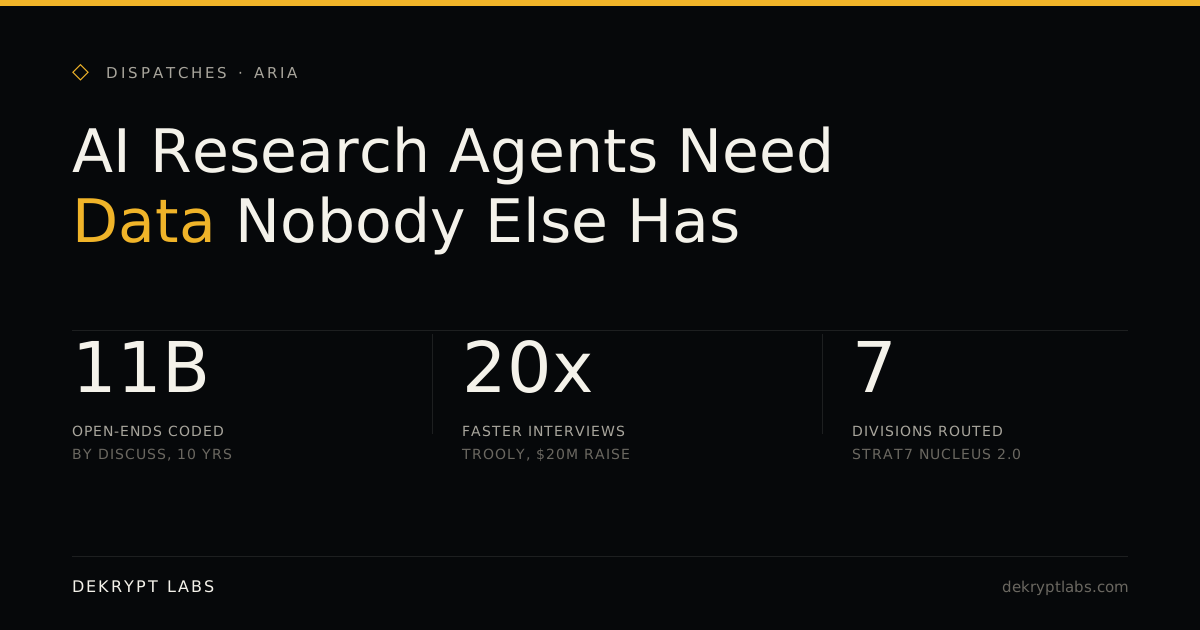
Discuss just told the market it has coded 11 billion open-ended survey responses over the past decade. That's not a headline about AI — it's a headline about what AI needs to be worth using.
The short version
- Discuss Intelligence turns a decade of coded open-ends (11 billion of them) into a plain-language query layer, tracing every answer back to the original participant and verbatim.
- Mintel's GNPD Deep Research replaces manual searches across millions of tracked product launches with evidence-based recommendations.
- NIQ's gfknewron Smart Insights pairs decades of proprietary retail data with AI reasoning — data first, reasoning second.
- Trooly raised roughly $20 million to run 45-minute AI-led interviews at 20 times the speed and a tenth of the cost of traditional research, building its data vault from zero.
- Rival Technologies shipped a Model Context Protocol (MCP) connection so clients can pull its human research straight into their own AI agents, alongside a new Emerging Consumer Index.
Why is every research firm suddenly shipping an AI agent?
Because late July 2026 turned into a coordinated reveal. In one week, Discuss, Mintel, NIQ, STRAT7, Nielsen, Rival Technologies, Reach3, Cyabra, and Trooly all announced AI-agent products for research and insights work, per Insight Innovation Ventures' roundup. None of them are selling "AI." They're selling access to something they already own.
Discuss's pitch is the cleanest example. Discuss Intelligence doesn't generate insights from nothing — it queries 11 billion open-ended responses the company has coded over ten years, and every answer traces back to the specific participant, segment, and verbatim clip that produced it. STRAT7's Nucleus 2.0 does something similar internally: it routes work autonomously across the firm's seven divisions so consultants, in the words of COO Jonathan Clough, can "spend more time interpreting the evidence" instead of assembling it.
What's the actual moat — the model or the data?
The data. Nielsen's chief product officer, Akhil Parekh, put it bluntly: the AI race "relies on most accurate data and that's what Nielsen owns." Every incumbent launch this week backs that claim up.
Nielsen's new Ad Intel AI turns decades of measurement history into a real-time conversational engine over MCP, replacing a static reporting dashboard. Mintel isn't building a smarter search bar either — GNPD Deep Research sits on millions of product launches tracked across decades and curated by category experts, which is what makes its recommendations defensible instead of generic. NIQ's framing for gfknewron Smart Insights is nearly identical: "trusted data plus AI reasoning," in that order, applied to decades of proprietary retail and consumer measurement.
Where does that leave AI-native challengers with no archive?
Compete on speed and access instead. Trooly has no decade of coded open-ends, so its roughly $20 million raise is funding an AI platform that conducts 45-minute in-depth interviews at 20 times the speed and a tenth of the cost of a human-moderated study — it's building the capture layer from scratch rather than mining one.
Rival Technologies took a different route. Rather than build a proprietary archive, it opened an MCP connection so clients can plug Rival's human research directly into their own AI agents, working with the data "on their own terms," per CEO Andrew Reid — alongside a new syndicated Emerging Consumer Index tracking Gen Z and Millennial spending across the US and Canada.
| Company | Asset behind the agent | What it actually ships |
|---|---|---|
| Discuss | 11B coded open-ends (10 years) | Plain-language query layer, traced to source |
| Mintel | Millions of tracked launches | Evidence-based GNPD recommendations |
| NIQ | Decades of retail/consumer data | gfknewron Smart Insights |
| Nielsen | Decades of ad measurement | Real-time conversational engine (MCP) |
| Trooly | None (new capture layer) | 45-min AI interviews, 20x faster, 1/10 cost |
| Rival | Human research + MCP access | Client agents query Rival data directly |
What does this mean for agencies without a data vault?
Most market-research agencies sit in the worst spot on that table: no decade of coded archive like Discuss, and no $20 million to build a new capture engine like Trooly's. What they have is client relationships and research design skill — and right now, that's the part of the job an agent pipeline can absorb fastest, from brief to questionnaire to a defensible narrative, without needing ten years of proprietary data first. That's the wedge we built ARIA around, and it's the same shift we've been tracking across recent dispatches.
The firms racing to ship AI agents this week aren't really competing on model quality — the underlying language models are close enough to each other. They're racing to expose the archive they already own before a rival does, or before a well-funded challenger like Trooly builds one that didn't exist. Agencies that never built an archive don't get to sit this fight out; for the data behind that argument, see our research page. They need to compete on how fast a brief becomes a finished deliverable instead.
Frequently Asked Questions
What is Discuss Intelligence and how does it use 11 billion open-ends? Discuss Intelligence is a research intelligence layer that lets teams query a company's entire coded research library in plain language. It draws on 11 billion open-ended responses coded over a decade, tracing every answer back to its original participant, segment, and verbatim clip.
Why did Nielsen, Mintel, and NIQ all launch AI research agents in the same week? Late July 2026 saw a coordinated wave of AI-agent launches from established research firms, each converting proprietary, decades-old datasets into AI-queryable products via Model Context Protocol or similar interfaces — turning static reports into tools clients can query continuously.
How is Trooly different from incumbents like Mintel or Nielsen? Trooly raised about $20 million to build an AI interview platform from scratch rather than mine an existing archive. It runs 45-minute AI-led interviews at roughly 20 times the speed and a tenth of the cost of traditional moderated research.
Does a proprietary data archive matter more than the AI model itself? Yes, based on how incumbents are positioning their launches. Nielsen's CPO called accurate proprietary data the deciding factor in the "AI race," and NIQ, Mintel, and Discuss all frame their agents as data-first, reasoning-second products.
Abhishek Gupta is Co-Founder at Dekrypt Labs, building ARIA — an AI research pipeline from brief to deck. dekryptlabs.com