The AI Research Pipeline Race Nobody's Won Yet
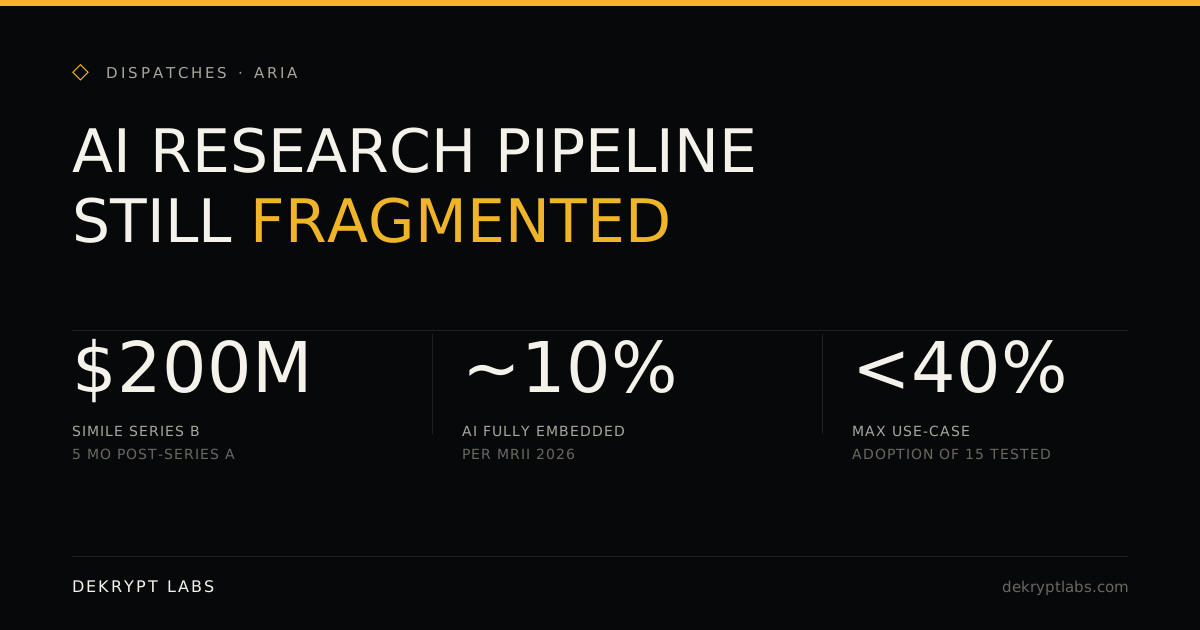
Simile closed a $200 million round at a $2 billion valuation on July 30, 2026 — five months after its $100 million Series A. Investors just priced the AI research pipeline at nine figures. Most research firms still don't have one.
That gap is the actual story. Not whether AI belongs in market research — that argument ended a year ago. The fight now is over who owns the pipeline from client brief to finished deck, and right now nobody does.
The short version
- Simile raised a $200M Series B led by Greenoaks at a $2B valuation, five months after a $100M Series A — a Stanford-founded startup that only left stealth in February 2026.
- MRII's 2026 State of the Market Research Industry study (498 professionals, published April 28, 2026) found roughly half of researchers use AI regularly — but only about 10% have it fully embedded in a standard workflow.
- Across 15 tested AI use cases in that same MRII study, not one exceeded roughly 40% adoption. Firms are trying everything and standardizing on nothing.
- aytm launched Skipper Reports on June 3, 2026, an AI layer that turns completed survey data into exportable executive summaries and branded decks — CEO Lev Mazin called it closing the "final mile" of delivery.
- PureSpectrum's Claude Connector, in beta since June 1, 2026, lets researchers run feasibility checks, launch surveys, and manage quotas from inside Claude via Model Context Protocol.
Why did investors just hand Simile $200 million for AI "twins" of consumers?
Simile builds what it calls agentic twins — AI agents trained on real interviews, behavioral data, and scientific literature — that enterprises query instead of running a fresh panel. Greenoaks, Index, Bain Capital Ventures, and CVS Health Ventures backed the round.
The bet isn't that twins are perfectly accurate. It's economic: querying a trained agent costs a fraction of fielding a new study, and it doesn't wait three weeks for field time. That math is why a company can jump from $100M to $200M raised in five months.
Is market research actually adopting AI, or just testing it?
MRII's numbers say testing, mostly. Roughly 50% of the 498 professionals surveyed use AI tools regularly. But only about 10% report AI is fully embedded in a standard workflow — the other 40% are using it ad hoc, tool by tool, task by task.
The 15-use-case ceiling makes the pattern clearer. No single application — not report drafting, not data cleaning, not respondent screening — cracked 40% adoption. That's not a maturity curve. It's a field running dozens of pilots that never graduate into infrastructure.
Where is the industry actually building infrastructure — and who owns the whole pipeline?
Two June 2026 launches show where vendors are placing bets, and both stop short of the full pipeline. aytm's Skipper Reports automates the back half: survey data in, formatted report out, with methodology documentation and follow-up suggestions attached. PureSpectrum's Claude Connector automates the front half: launching and monitoring fielding conversationally, without leaving an AI chat window.
Neither touches the middle — proposal writing, questionnaire design, the analytical narrative that connects raw numbers to a client's actual question. That's the gap between "AI-assisted reporting" and an actual AI research pipeline: one system that carries a brief from intake to deck without a human re-keying data between three separate tools.
| Vendor | Launch date | What it automates | What it skips |
|---|---|---|---|
| aytm (Skipper Reports) | Jun 3, 2026 | Data → formatted report/deck | Proposal, questionnaire design |
| PureSpectrum (Claude Connector) | Jun 1, 2026 (beta) | Survey launch, fielding, quotas | Analysis, narrative, delivery |
| Simile | Jul 30, 2026 ($200M raise) | Synthetic respondent querying | Everything downstream of the data |
What does a full AI research pipeline actually replace?
Not the researcher — the handoffs between research design, fielding, analysis, and delivery, which today happen across separate tools and separate people. A single pipeline collapses brief-to-proposal-to-questionnaire-to-analysis-to-deck into one continuous run instead of four manual relays, each one a place for scope drift or a missed deadline.
This is the exact gap we built ARIA to close: a client brief goes in, and the full deliverable set — proposal, questionnaire, analysis, narrative, deck — comes out of one agent pipeline instead of four disconnected tools stitched together by an exhausted account manager.
The capital is already flowing at scale, and the point-solutions are proving the pieces work in isolation. What's still missing, per MRII's own data, is the 90% of the industry that hasn't turned any of it into a real workflow. That's not a technology gap anymore. It's an integration gap, and it's the one worth watching in 2026.
Frequently Asked Questions
What is an AI research pipeline in market research? An AI research pipeline is a system that automates a research project end-to-end — from client brief and proposal through questionnaire design, fielding, analysis, and final report — instead of using separate tools for each stage with manual handoffs in between.
How much AI adoption exists in market research in 2026? Per MRII's 2026 industry study of 498 professionals, roughly half use AI tools regularly, but only about 10% report it's fully embedded in a standard workflow. No single AI use case among 15 tested exceeded roughly 40% adoption.
What did Simile raise and what does it do? Simile raised a $200 million Series B led by Greenoaks at a $2 billion valuation on July 30, 2026, five months after a $100 million Series A. It builds "agentic twins" — AI agents trained on real human data — that enterprises query instead of fielding new consumer panels.
Why hasn't one company automated the full research pipeline yet? Current tools automate pieces — PureSpectrum's Claude Connector handles fielding, aytm's Skipper Reports handles report generation — but the middle of the pipeline, proposal and questionnaire design plus analytical narrative, still runs through manual work at most firms.
Abhishek Gupta is Co-Founder at Dekrypt Labs, building ARIA — an AI research pipeline from brief to deck. dekryptlabs.com
Read more on Dekrypt Labs Dispatches and our research.