Auditable AI Underwriting: Why Money Moved Anyway
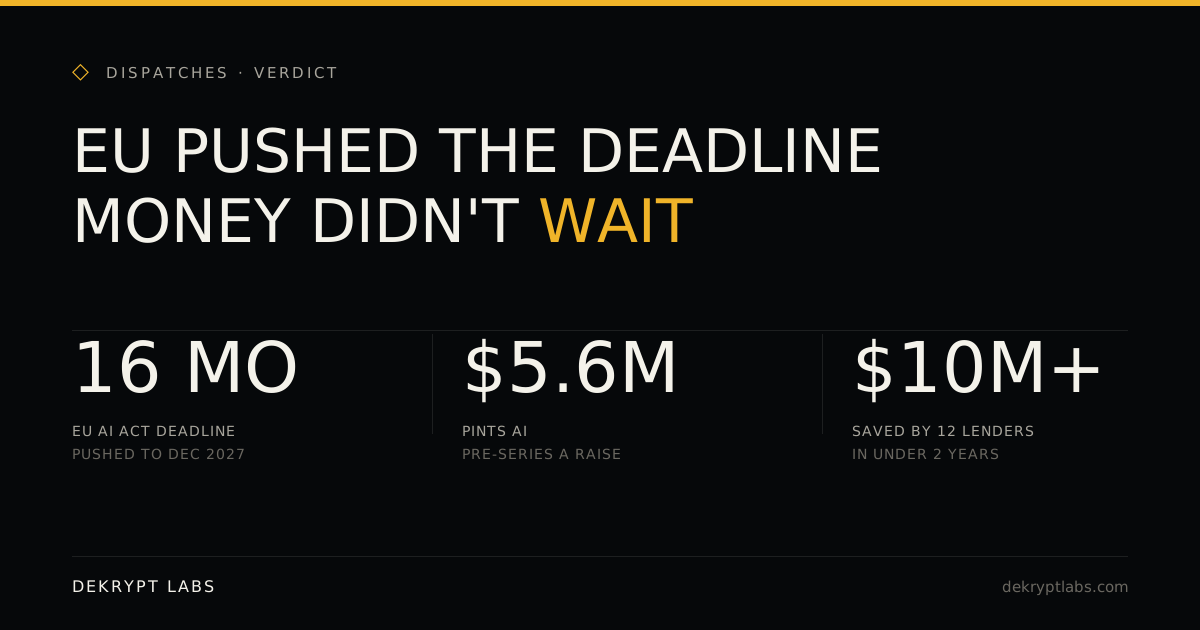
On June 29, 2026, the EU quietly gave every bank and lender an extra 16 months before AI credit-scoring tools have to prove they're explainable. Two weeks earlier, investors had already put $5.6 million into a startup that does nothing but that.
That's the tell. When regulators loosen a deadline and money tightens around the exact thing the deadline was meant to force, the market isn't waiting for the rulebook. It has already decided auditable AI underwriting is table stakes.
The short version
- The EU AI Act classifies AI systems that assess a person's creditworthiness as "high-risk" under Annex III, point 5(b), triggering mandatory logging, explainability, and human-oversight obligations.
- On June 29, 2026, the Council of the EU approved a Digital Omnibus that pushed the compliance deadline for standalone high-risk systems like credit scoring from August 2, 2026 to December 2, 2027 — a 16-month deferral.
- Non-compliance still carries real teeth: fines up to €35 million or 7% of global turnover for the worst violations.
- Days before the delay, Singapore's Pints AI raised $5.6 million pre-Series A — led by Japan's SBI Ven Capital and Tin Men Capital — specifically to scale an "auditable AI" platform for underwriting, claims, and onboarding.
- Pints AI's own numbers: 12 financial institutions across four countries have used its Autothought platform for credit decisioning and collectively saved more than $10 million in under two years.
- India has no equivalent explainability mandate for credit AI today — which means the audit trail is currently a choice, not a requirement, for every NBFC building or buying underwriting automation.
Why did regulators delay the rule they just wrote?
The EU AI Act's Annex III already named credit scoring a high-risk use case, with an August 2, 2026 compliance deadline. The Digital Omnibus, approved by the Council on June 29, 2026, pushed that to December 2, 2027 for standalone systems — reportedly because banks and insurers weren't ready to certify their models in time. Compliance guides are still telling institutions to plan as if August 2026 were binding, since the extension isn't guaranteed to survive final implementation.
What is Pints AI actually selling, and why does the funding matter?
Pints AI's Autothought platform doesn't build a better credit model — it wraps whatever model a lender already uses (small language models, frontier models like Claude, or open-source) in a layer that logs and explains every decision. That's precisely the Annex III obligation regulators just deferred. A $5.6 million round, co-led by Japan's SBI Ven Capital and Tin Men Capital with Seeds Capital, NTUitive, SUTD Venture Fund, and Tenity participating, is a bet that lenders will want the audit trail regardless of when the law actually bites.
Does India face the same requirement?
No. Neither the RBI nor any Indian statute currently classifies AI-based credit scoring as a regulated, auditable category the way the EU's Annex III does. NBFCs deploying AI underwriting in India today do so under general fair-lending and data-protection norms, not a credit-AI-specific explainability mandate — for now.
The gap that matters for underwriting teams
| EU (post-delay) | India (today) | |
|---|---|---|
| Credit-AI explainability mandate | Yes, from Dec 2, 2027 | None specific to AI |
| Logging/audit-trail requirement | Statutory (Annex III + Article 12) | Best practice only |
| Penalty for non-compliance | Up to €35M / 7% turnover | Not yet defined |
| Investor appetite for auditable tools | Already funded ($5.6M+ round) | Emerging |
A regulatory gap isn't a reason to skip the audit trail — it's a head start. Every underwriting decision a lender makes today, EU-bound or not, eventually meets a credit committee, a regulator, or a bad-loan writeoff that asks "why did the model say yes." An NBFC that can answer that question with a logged, reconstructable reasoning chain isn't just compliant-in-advance; it's running a more defensible credit book than one that can't.
That's the exact gap Verdict is built to close for underwriting and investment proposals — turning financials and diligence into a recommendation that's sourced and reconstructable, not a black box a credit committee has to take on faith.
Regulators bought the industry 16 months. The smart underwriting shops won't spend that time waiting for the deadline — they'll spend it building the paper trail before anyone forces them to.
Frequently Asked Questions
What is Annex III of the EU AI Act? Annex III lists AI use cases classified as "high-risk," including systems that evaluate a person's creditworthiness or credit score. High-risk classification triggers mandatory logging, explainability, human oversight, and conformity-assessment obligations before deployment in the EU.
When do EU credit-scoring AI rules actually take effect? Originally August 2, 2026. The Council of the EU approved a Digital Omnibus on June 29, 2026, deferring standalone high-risk systems like credit scoring to December 2, 2027 — but compliance guides still advise treating August 2026 as binding until the extension is finalized.
Does India regulate AI-based credit underwriting the way the EU does? Not specifically. Indian NBFCs operate under RBI fair-lending, data-protection, and general underwriting-standards guidance, but there is currently no statute that classifies AI credit-scoring models as a distinct high-risk, auditable category the way EU Annex III does.
Why did investors fund an auditable-AI startup right as the deadline got pushed back? Because the underlying demand — lenders wanting to explain and defend AI-driven credit decisions to committees, auditors, and regulators — doesn't depend on a specific statutory deadline. Pints AI's $5.6 million raise and its 12-institution track record suggest that demand already exists independent of enforcement dates.
Explore more regulatory and underwriting intelligence in our dispatches and deeper research.
Abhishek Gupta is Co-Founder at Dekrypt Labs, building Verdict — AI-assisted underwriting and investment proposals. dekryptlabs.com