RBI Holds Rates at 5.25%: The Business Intelligence Gap
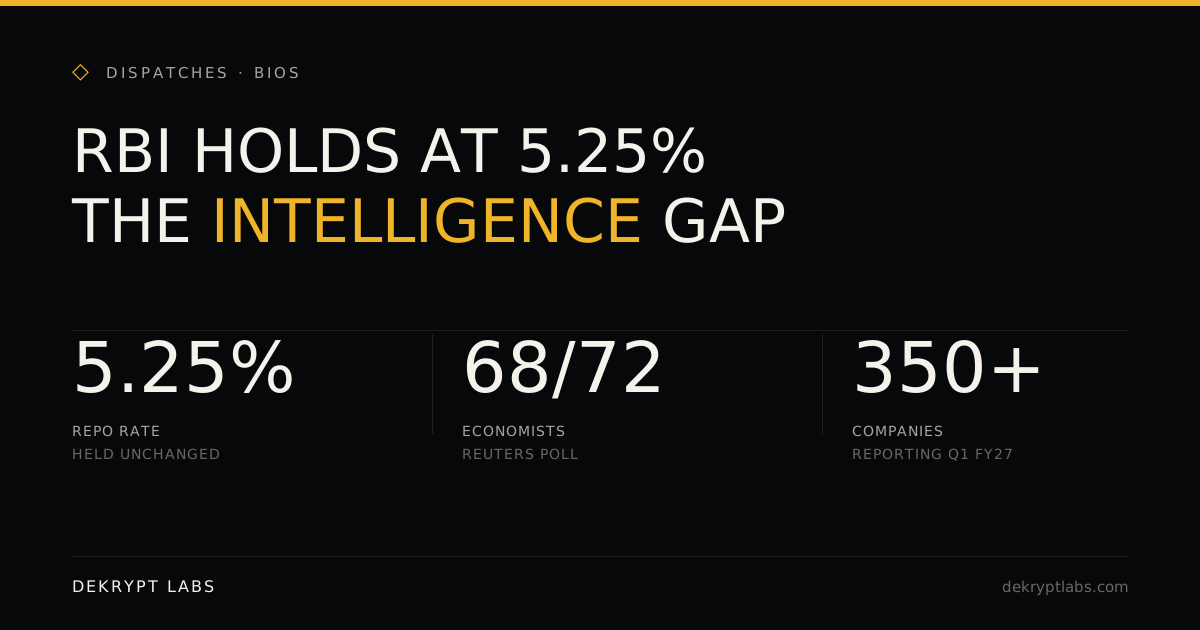
Sixty-eight of the 72 economists Reuters polled this week called it correctly: the RBI's Monetary Policy Committee held the repo rate at 5.25% on August 5, 2026. That's the tightest consensus a rate call has drawn all year — and it's exactly why so many founders will misread it.
A near-unanimous forecast feels like a low-risk week. It isn't. The same seven days that produced this hold also produced Q1 FY27 earnings from more than 350 companies — State Bank of India, Bharti Airtel, LIC, Titan among them — landing on top of an inflation print that's already above target. Agreement on the headline number tells you nothing about what it means for your business specifically.
The short version
- The RBI's MPC held the repo rate at 5.25% on August 5, 2026, matching what 68 of 72 economists surveyed by Reuters had predicted, per Business Today's coverage of the meeting.
- Retail inflation rose to 4.38% in June 2026 — above the RBI's 4% medium-term target, but still inside its 2–6% tolerance band.
- The RBI left its FY27 inflation forecast at 5.1% and its GDP growth forecast at 6.6%, unchanged from the prior review.
- The RBI had already cut rates by a cumulative 125 basis points through 2025, so this hold is a pause on an easing cycle, not a return to tightening.
- More than 350 companies reported Q1 FY27 results in the same week as the rate call, per Goodreturns' results calendar — a volume no founder reads end to end.
Why did 68 of 72 economists agree the RBI would hold?
Because the inputs pointed one direction: inflation ticked up but stayed inside the tolerance band, crude oil prices climbed on West Asia tensions, and the RBI had already spent its easing room in 2025. Holding was the low-drama option.
That consensus is a forecast about the RBI's behavior, not a verdict on your business. A logistics company financing a fleet expansion and a D2C brand sitting on inventory both read "held at 5.25%" — and it means opposite things for their next quarter's cash flow.
What does a hold at 5.25% actually change for a business?
Less than the headline suggests, and more than "nothing" suggests. The RBI's unchanged 6.6% GDP growth forecast for FY27 means the central bank isn't signaling a slowdown severe enough to justify further cuts. Its unchanged 5.1% inflation forecast means it expects price pressure to ease on its own, without additional tightening.
For a working-capital-heavy business — a distributor, a contractor, an SME with receivables cycles — that combination argues for locking in current borrowing costs rather than waiting for a cut that a 125-basis-point easing cycle already delivered most of. For a fixed-cost SaaS business, the same decision is closer to background noise. Same rate call, opposite implication, and the difference is entirely in how it maps onto your specific balance sheet — not in the RBI's press release.
Why does more information make the decision harder, not easier?
Because volume isn't synthesis. Three-hundred-fifty-plus earnings reports and a rate decision landing in the same five trading days means a founder trying to track both manually is choosing between reading everything shallowly or reading almost nothing at all.
A Reuters poll of 72 economists exists precisely because no single analyst can hold every input in their head at once — and that poll is still just about the RBI's decision, not about what SBI's or Bharti Airtel's Q1 numbers mean for a supplier three tiers down their vendor chain. Consensus on the macro call doesn't reduce the parsing work for the micro question a specific business actually needs answered.
Where does traditional research fall short here?
A McKinsey-style engagement can answer "what does this mean for my business" — in three to six weeks, at a price most SMBs never see quoted. By the time the deck lands, the rate cycle has usually moved again. The gap this week exposes isn't a lack of data — Reuters, the RBI, and 350 earnings calls generate more of it than anyone can read — it's the absence of something that turns a plain-English question ("does this hold change my working capital plan?") into a sourced, confidence-scored answer before the decision window closes. That's the specific problem BIOS is built against.
Frequently Asked Questions
Why did the RBI hold the repo rate at 5.25% instead of cutting further? Retail inflation rose to 4.38% in June 2026, above the RBI's 4% target, while crude oil prices climbed on geopolitical tensions. With 125 basis points of cuts already delivered in 2025, the MPC chose to pause rather than risk reigniting inflation.
Does a rate hold help or hurt Indian SMBs? It depends on the business. Working-capital-heavy firms benefit from locking in current borrowing costs since further cuts look unlikely soon; fixed-cost or asset-light businesses see little direct impact from the hold itself.
What is the RBI's inflation and growth forecast for FY27? The RBI kept its FY27 inflation forecast at 5.1% and GDP growth forecast at 6.6%, both unchanged from its prior monetary policy review, signaling no shift in its underlying economic outlook.
Why did so many companies report earnings in the same week as the RBI decision? Companies must file quarterly results within 60 days of quarter-end, which compresses Q1 FY27 (April–June) reporting into a narrow window in early August — the same week the RBI's bi-monthly policy cycle happened to fall.
For more on how founders are reading market signals in real time, see our dispatches and the underlying research behind them.
Interpreting one rate decision is manageable. Interpreting it alongside 350 earnings reports, in the same week, against your own balance sheet, is the actual job — and it's the job most businesses have no system for. The RBI will meet again in October. The volume of signal won't shrink between now and then.
Abhishek Gupta is Co-Founder at Dekrypt Labs, building BIOS — a Business Intelligence Operating System for Indian businesses. dekryptlabs.com