Cardiac Monitoring for Elderly Living Alone: The Gap
A 2024 trial put 14-day heart monitors on thousands of people 70 and older to catch undiagnosed atrial fibrillation before it caused a stroke. Stroke hospitalizations came in at 0.7% in the screened group versus 0.6% in usual care — a difference so small it isn't clinically meaningful (JACC). Two weeks of watching wasn't enough. That result is the real argument for cardiac monitoring for elderly living alone that runs every night, not once.
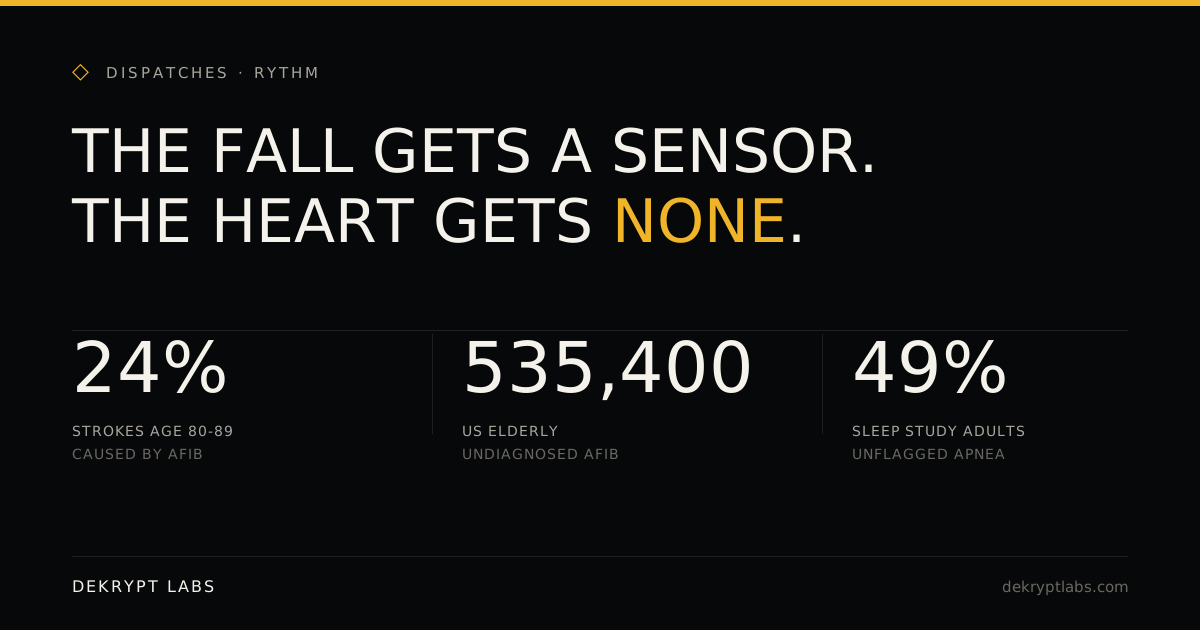
Fall detection gets most of the attention in eldercare tech — cameras, pendants, Wi-Fi sensing that catches a person hitting the floor. The heart gets almost none. That's backwards, because an irregular heartbeat kills people days or weeks before anyone notices, not in the ten seconds a fall does.
The short version
- Atrial fibrillation (AFib) causes roughly 24% of strokes in people aged 80 to 89 — the highest share of any age band, and rising with age.
- An estimated 535,400 elderly Americans have undiagnosed AFib, about 1.3% of the elderly population, and 77% of them already carry a stroke-risk score (CHADS₂ ≥1) that would normally trigger blood thinners (NCBI).
- Total AFib prevalence — diagnosed plus undiagnosed — runs at 10.0% among elderly adults, meaning roughly one in ten older people is living with a heart rhythm problem right now, known or not.
- The 2024 GUARD-AF trial screened people 70+ with a 14-day continuous ECG patch and found no meaningful drop in stroke hospitalizations versus standard care (PubMed).
- A 2024 JMIR study fitted 35 community-dwelling adults aged 65-83 with contactless under-mattress and bedside sensors overnight; 49% of them turned out to have moderate-to-severe sleep apnea nobody had flagged (JMIR mHealth).
Why doesn't periodic screening catch atrial fibrillation in older adults?
Because AFib is often paroxysmal — it comes and goes in episodes that can last minutes. A 14-day patch has to be worn during the exact window an episode happens, and GUARD-AF shows that even two full weeks of continuous ECG monitoring in over-70s didn't move stroke outcomes (JACC). A snapshot, however long, can still miss the event that matters.
What does a nonvalvular AFib diagnosis actually mean for stroke risk?
Nonvalvular atrial fibrillation raises stroke risk four to five times over someone with a normal heart rhythm (MedLink Neurology). That multiplier holds even for episodes a person never feels — silent AFib is exactly as dangerous as the kind that causes chest-thumping palpitations, which is part of why undiagnosed cases stay undiagnosed for years.
| Monitoring approach | Coverage window | Misses paroxysmal AFib? | Needs a wearable? |
|---|---|---|---|
| Annual ECG at a checkup | Seconds | Almost always | No |
| 14-day continuous patch (GUARD-AF) | 2 weeks | Often — trial showed no outcome shift | Yes |
| Contactless overnight sensing | Every night, indefinitely | Rarely — full sleep cycle, every cycle | No |
Where does sleep fit into a heart problem?
Sleep is where irregular rhythms are easiest to catch and hardest to notice unaided. The JMIR study's under-mattress trackers picked up both heart rate and breathing rate through a full night, no device on the body, and surfaced sleep apnea — a known trigger for AFib episodes — in half the study group (JMIR mHealth). For an older adult sleeping alone, that's also the exact window when nobody is present to notice labored breathing or a racing pulse.
This is the gap Rythm is built for — the same Wi-Fi CSI and mmWave sensing that catches a fall can also track breathing and heart rhythm through the night, continuously, without a wearable a person has to remember to charge or a camera in their bedroom.
Contactless sensing doesn't diagnose AFib on its own — it flags the pattern change (a resting heart rate that's drifted, breathing that's grown irregular, a rhythm that looks off night over night) that tells a family or a clinician where to look next. That's a materially different job than a pendant that only fires after someone has already fallen.
The bigger point sits underneath both technologies: elder-safety tech has spent a decade optimizing for the visible emergency — the fall, the 3 a.m. wander — while the slower, quieter failure mode running in the background gets a fraction of the engineering attention and a fourteen-day monitor once a decade, if that. Fix the sensing cadence and you fix the actual gap. More on how contactless sensing works in practice is in our dispatches, and the underlying research trail is indexed at Dekrypt Labs research.
Nightly, ambient monitoring won't replace a cardiologist, and it shouldn't try to. But it closes the exact gap GUARD-AF exposed — the distance between "screened once" and "watched continuously" — for the population that has the least ability to self-report a problem it can't feel. That's not a features race. It's a coverage-window problem, and right now most of the industry is still solving it with a stopwatch instead of a night's sleep.
Frequently Asked Questions
What is cardiac monitoring for elderly living alone, and how is it different from a fall alert? Cardiac monitoring tracks heart rhythm and breathing patterns over time — usually overnight — to catch irregularities like atrial fibrillation before they cause a stroke. A fall alert only activates after a fall has already happened, so the two solve different problems.
Can Wi-Fi sensing actually detect an irregular heartbeat? Wi-Fi Channel State Information (CSI) and mmWave radar can detect the tiny chest movements tied to breathing and, in research settings, heart rate — without a wearable. It flags pattern changes for follow-up rather than delivering a clinical diagnosis on its own.
Why did the GUARD-AF trial find no benefit from 14-day heart monitoring? Atrial fibrillation is often paroxysmal, meaning it comes and goes in short episodes. A 14-day monitoring window can still miss the episode that matters, which is why the trial found no meaningful drop in stroke hospitalizations versus usual care.
How common is undiagnosed atrial fibrillation in older adults? An estimated 535,400 elderly Americans — about 1.3% of that population — have undiagnosed AFib, and most already carry a stroke-risk score high enough to normally warrant treatment. Total AFib prevalence, diagnosed and undiagnosed combined, is around 10% among elderly adults.
Abhishek Gupta is Co-Founder at Dekrypt Labs, building Rythm — contactless cardiac and safety sensing for elderly people living alone. dekryptlabs.com