Credit Appraisal Memo: Why NBFC Underwriting Takes Weeks
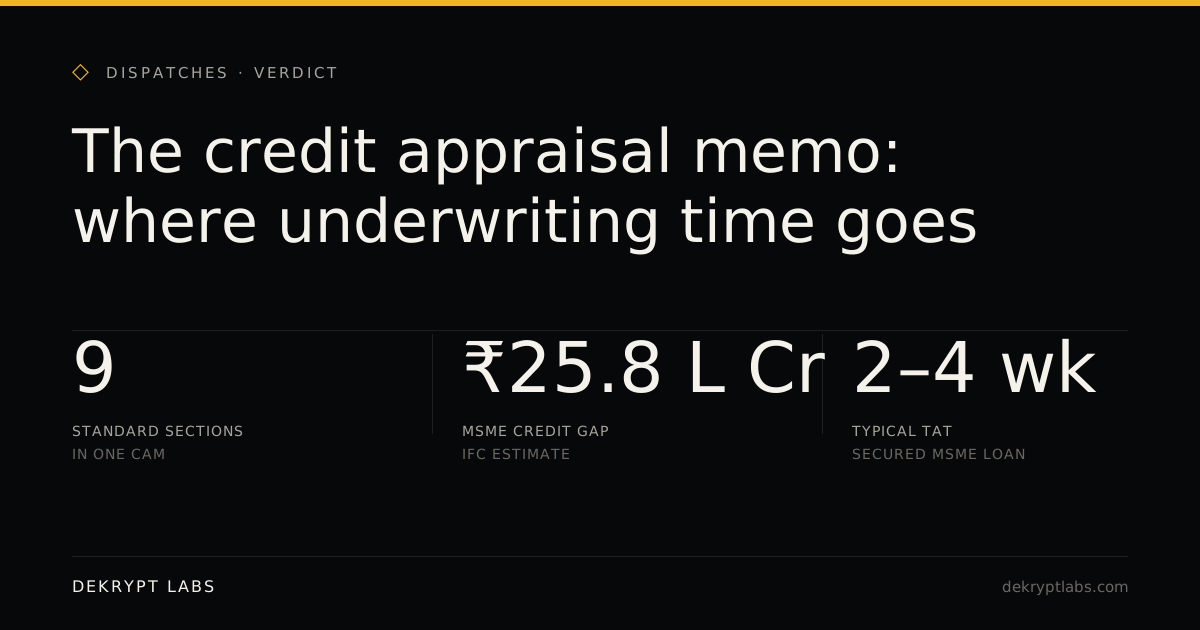
A secured MSME loan at a mid-sized NBFC takes two to four weeks to underwrite. The borrower's GST returns, bank statements, and bureau report are digital on day one. The bottleneck is a document most people outside credit teams have never heard of: the credit appraisal memo, or CAM.
The CAM is where every piece of borrower data gets read, interpreted, and turned into a recommendation a credit committee can sign. It is also where most of the time goes.
The short version
- The credit appraisal memo is the single document where a lender records why it lent — borrower profile, financials, banking conduct, bureau history, collateral, ratios, deviations, and a recommendation.
- India's MSME credit gap was estimated at ₹25.8 lakh crore (about $397 billion) by the IFC in its 2018 study — and underwriting throughput, not demand, is one of the binding constraints.
- The inputs went digital years ago: GST returns, Account Aggregator bank data (live since September 2021), TransUnion CIBIL's CMR rank for MSMEs, and 4 crore+ Udyam registrations.
- A typical CAM runs 9 sections and 15–40 pages. An analyst assembles it by hand from 5–8 separate systems.
- The counterintuitive part: a CAM's real job is not approving the loan. It is making the decision defensible three years later, when the account is under review.
What Is a Credit Appraisal Memo?
A credit appraisal memo is the internal document an NBFC or bank prepares before sanctioning a loan. It consolidates the borrower's business profile, financial statements, banking conduct, bureau record, and collateral into a structured case, ends with ratio analysis and deviations, and closes with a recommendation the sanctioning authority approves or rejects.
The format varies by lender, but the skeleton barely does. A working CAM for a secured MSME exposure covers roughly nine sections:
| Section | What it answers |
|---|---|
| Borrower & promoter profile | Who is asking, and what is their track record? |
| Business & industry note | How does the firm earn, and how cyclical is the sector? |
| Financial analysis | What do 2–3 years of P&L and balance sheet say? |
| Banking conduct | Do the bank statements match the declared turnover? |
| Bureau analysis | How has the borrower repaid everyone else? |
| Collateral & security | What backs the exposure, and at what cover? |
| Ratio sheet | DSCR, TOL/TNW, current ratio, interest coverage — against policy thresholds. |
| Deviations | Where does this case breach policy, and who approved the breach? |
| Recommendation | Amount, tenor, pricing, conditions precedent. |
Each section reads simply. The work is in reconciliation: the turnover in the GST returns must square with the P&L, which must square with credits in the bank statement. When the three disagree — and in MSME files they usually do — the analyst has to explain the gap, not just note it.
The Data Went Digital. The Memo Didn't.
Every major input to a credit appraisal memo now arrives as structured data.
GST returns give monthly, invoice-backed turnover. The Account Aggregator framework has delivered consented, machine-readable bank statements since it went live in September 2021. TransUnion CIBIL scores MSMEs on a 10-point CMR scale, where CMR-1 to CMR-3 flags the lowest-risk borrowers. Udyam registration — past 4 crore enterprises — gives a verifiable identity and classification for the borrower itself.
So the raw material reaches the lender in hours. Then it enters a workflow built for paper. An analyst downloads the bureau PDF, pastes financials into a spreadsheet template, runs a bank statement analyser, and types the narrative sections by hand. The memo travels by email to a credit manager, who sends back queries. Two or three query loops later, the CAM reaches committee.
That loop — not KYC, not disbursal — is where the two-to-four-week turnaround lives. It is also why underwriting capacity scales linearly with analyst headcount, which is exactly the constraint a ₹25.8 lakh crore credit gap punishes.
The CAM Is a Defence Document, Not a Sales Document
Here is the part that changes how you read every section above: the memo's primary audience is not today's credit committee. It is whoever reopens the file later — the RBI inspector, the statutory auditor, the internal review after the account slips.
When a loan turns bad, nobody asks whether the decision was fast. They ask whether the deviation was recorded, whether the DSCR was computed on the stated basis, whether the bureau pull was current at sanction, and whether the recommendation follows from the evidence on the page. Under the 90-day NPA norm now mandatory for every NBFC, that review clock starts sooner than it used to.
This is why "just approve faster" is the wrong goal for underwriting automation. A one-line score with no traceable reasoning speeds up sanction and slows down every audit that follows. The document has to get faster without getting thinner.
The gap we keep seeing in real files is consistency: the same borrower data, given to two analysts, produces two CAMs with different DSCR treatments and different deviation lists. That is the specific problem Verdict is built against — structured underwriting proposals where every number carries its source and every recommendation traces back to evidence, so the memo is defensible by construction rather than by the analyst's discipline that week.
Where the Time Should Go
Strip the assembly work — fetching, pasting, reconciling, formatting — and what remains is the judgment work: is this promoter's second business a strength or a drain, is the sector's cycle turning, is the collateral genuinely marketable at the stated value.
That judgment is what credit heads are paid for, and it currently gets the last 10% of the analyst's week. The lenders who fix the ratio between assembly and judgment will underwrite more MSME files per analyst without loosening a single policy threshold. The ones who don't will keep quoting three-week turnarounds into a market that has already moved its data online.
Frequently Asked Questions
What is a credit appraisal memo (CAM) in lending? A credit appraisal memo is the internal document a lender prepares before sanctioning a loan. It consolidates the borrower's profile, financials, banking conduct, bureau history, collateral, ratios, and policy deviations into a structured case, ending with a recommendation that the credit committee approves, modifies, or rejects.
Why does NBFC underwriting take 2–4 weeks if the data is digital? Because the memo is still assembled manually. Analysts pull GST returns, bank statements, and bureau reports from separate systems, reconcile mismatches by hand, and route the draft through multiple query loops with credit managers before it reaches committee. Assembly and reconciliation, not data access, consume the timeline.
What ratios does a CAM typically include for MSME loans? The standard set is DSCR (debt service coverage ratio), TOL/TNW (total outside liabilities to tangible net worth), current ratio, and interest coverage, each compared against the lender's policy thresholds. Cases breaching a threshold must be recorded as deviations with explicit approval from a higher sanctioning authority.
Can AI replace the credit analyst who writes the CAM? No — it replaces the assembly work, not the judgment. AI-assisted underwriting can fetch, reconcile, and structure borrower data with full source traceability, but assessing promoter quality, sector cycles, and collateral marketability remains the analyst's call. The gain is analysts spending their week on judgment instead of formatting.
Request access to Verdict → dekryptlabs.com/dispatches
Abhishek Gupta is Co-Founder at Dekrypt Labs, building Verdict — AI-assisted underwriting and investment proposals. dekryptlabs.com