Dabur Needed Accenture for Real-Time Business Intelligence
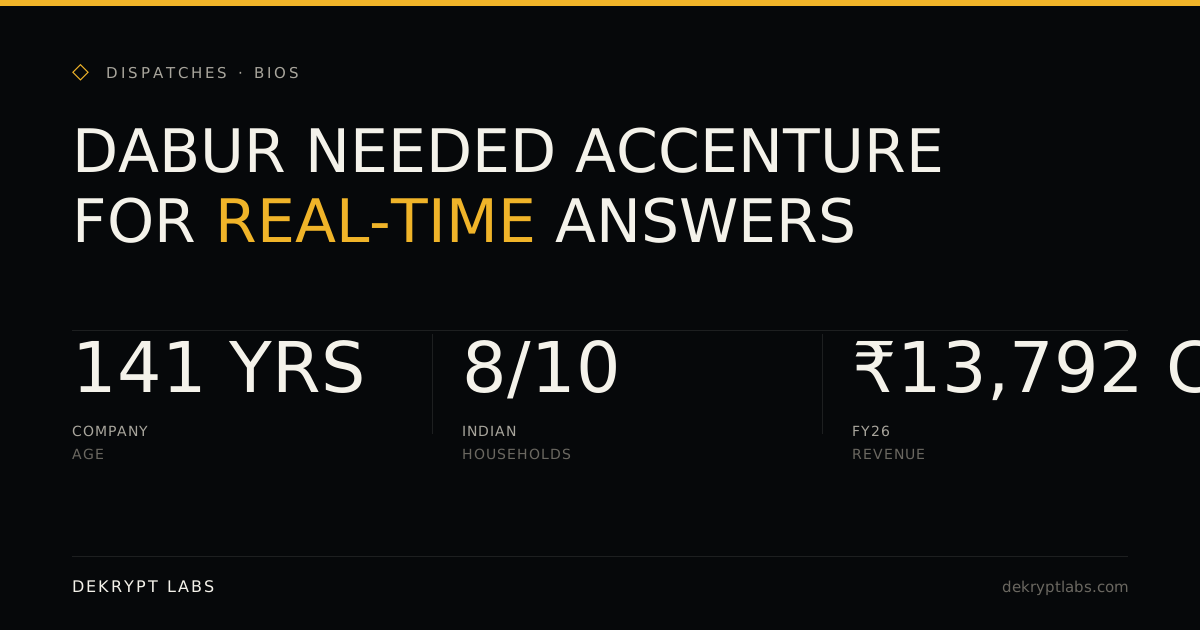
A company that's been in business for 141 years and sits in 8 out of 10 Indian homes still had to sign a multi-year deal with Accenture this month just to answer one question in real time: how is my business actually doing right now.
That's the real story behind Dabur India's AI partnership with Accenture, announced August 4, 2026. Dabur runs four brands worth over ₹1,000 crore each — Dabur Amla, Dabur Red Toothpaste, Real, Vatika — on top of ₹13,792 crore in FY26 revenue. It has finance teams, procurement teams, and decades of sales data. And it still needed outside help to build what its own Global CIO called a "digital brain."
The short version
- 141 years, 8 of 10 households, ₹13,792 crore revenue — Dabur's scale, per its FY26 results reported by Business Standard — and it still lacked a real-time view of its own operations.
- The Accenture deal builds a unified data lake merging structured and unstructured data from finance, procurement, marketing, and sales into one foundation.
- On top of that foundation: "control towers" and digital dashboards giving leaders real-time KPI visibility — the actual deliverable is faster answers, not more data.
- Accenture brings ~799,000 employees and ~$70 billion in FY25 revenue to this kind of engagement — scale most companies, including most large ones, don't have in-house or on retainer.
- Separately, 40% of Indian enterprises report significant or full AI use versus a 28% global average, per Deloitte's State of AI in the Enterprise 2026 — adoption is ahead of the world, but this deal shows even leaders are still building the plumbing.
Why does a company Dabur's size still need to buy this?
Because AI adoption and data infrastructure are two different projects, and India has been ahead on the first while lagging on the second. Deloitte's 2026 report found India ranks first out of 15 countries surveyed for using AI in strategic decision-making — but that's usage, not foundation.
Dabur's Global CIO Manas Mehra put it plainly: the goal is "building a digital brain on strong data foundations and advanced AI." Note the order — foundations first. Without a unified source of truth, an AI system doesn't give a wrong answer loudly; it gives a plausible-sounding one quietly, pulling from stale spreadsheets and disconnected systems that were never meant to talk to each other.
What is a "digital brain," and why does it need a multi-year contract?
It's a control layer that pulls finance, procurement, marketing, and sales data into one place and answers business questions from it in real time, replacing manual reporting cycles. It takes years, per Accenture's Ankur Chaudhary, because integrating decades of disconnected systems — not the AI model on top — is the actual engineering problem.
Chaudhary, who leads Accenture's Products Group for its India business, said the point is that "by strengthening its data foundation and embedding AI into core processes, Dabur can make faster decisions." That framing matters: the AI isn't the product here. The data foundation is. AI is just the layer that makes it queryable in plain language instead of a quarterly deck.
The gap this deal actually reveals
| What Dabur bought | What most Indian businesses have instead |
|---|---|
| Unified data lake across finance, procurement, marketing, sales | Data scattered across ERP, Excel, and someone's memory |
| Real-time control towers and dashboards | Monthly or quarterly review decks |
| A named multi-year Accenture engagement | No budget line for this at all |
| ~799,000-person consultancy behind the build | An internal team already stretched thin |
Dabur could write this check because it had ₹13,792 crore in revenue to justify it. A mid-market manufacturer, a regional retail chain, or a growing D2C brand doing ₹50-500 crore in revenue has the same underlying problem — scattered data, no real-time answers — and none of Dabur's budget to fix it with a bespoke Accenture build.
This is the gap BIOS exists to close: the same "ask a plain-English question, get a verified answer" outcome Dabur is paying years and a nine-figure engagement for, without needing an in-house data engineering team or an Accenture retainer first.
Frequently Asked Questions
What did Dabur and Accenture actually announce? On August 4, 2026, Dabur India signed a multi-year partnership with Accenture to build a unified data foundation and AI-powered "digital brain" — integrating finance, procurement, marketing, and sales data into real-time dashboards and control towers for faster decisions.
Why does a large company like Dabur need outside help for business intelligence? Scale doesn't automatically mean unified data. Dabur runs decades of operations across many systems that were never built to talk to each other; connecting them into one real-time source of truth is a multi-year integration problem, not something existing internal teams typically have spare capacity for.
Is India ahead or behind on enterprise AI adoption? Ahead on usage, behind on infrastructure. Deloitte's 2026 report found 40% of Indian enterprises report significant or full AI use versus 28% globally, and India ranks first for using AI in strategic decisions — but deals like Dabur's show even large players are still building the data foundation underneath it.
Can smaller companies get real-time business intelligence without a deal like Dabur's? Yes — the underlying need (plain-English questions answered from real data, in real time) doesn't require Dabur's revenue or Accenture's headcount. It requires a platform built to do that specific job rather than a bespoke, multi-year systems-integration engagement.
Read more on Dekrypt Labs Dispatches and our ongoing research into how Indian businesses actually make decisions.
Abhishek Gupta is Co-Founder at Dekrypt Labs, building BIOS — a Business Intelligence Operating System for Indian businesses. dekryptlabs.com