Fall Detection for Elderly: No Cameras, No Wearables
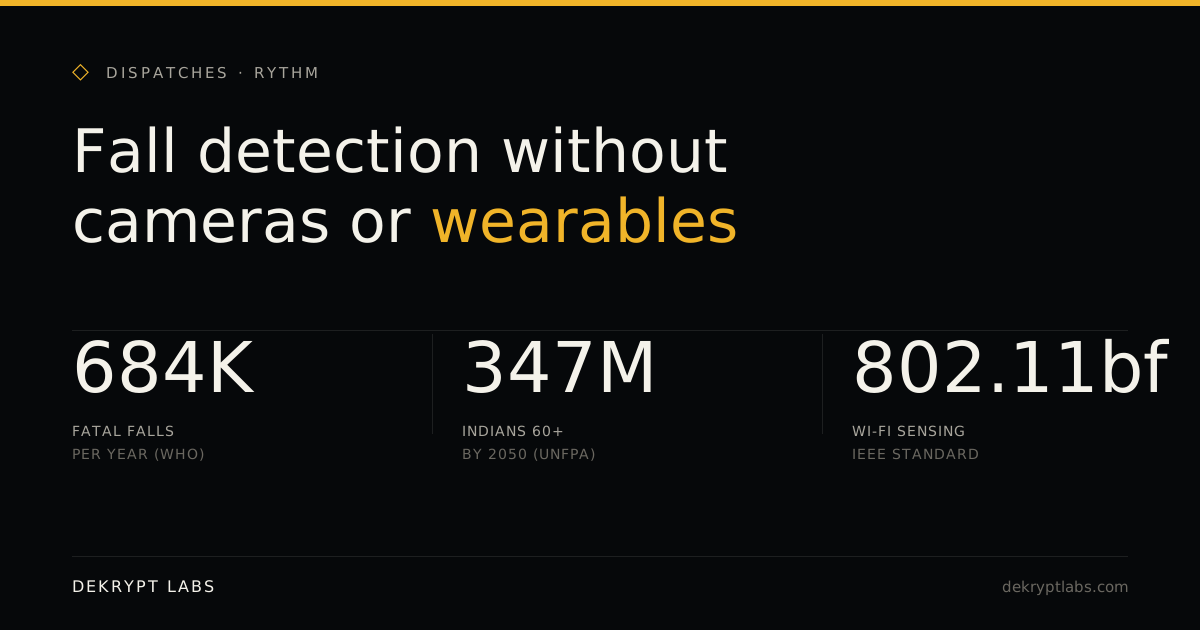
Falls kill about 684,000 people a year worldwide — the second leading cause of unintentional injury death, behind only road traffic. For an older person living alone, the fall itself is often not the worst part. The worst part is the floor afterwards — the hours nobody knows it happened.
That is the problem fall detection for elderly people has to solve. And the two dominant answers — the pendant alarm and the camera — both fail in ways their brochures never mention.
The short version
- The WHO attributes roughly 684,000 deaths a year to falls, and adults over 60 suffer the greatest number of fatal falls of any age group.
- India will have about 347 million people aged 60+ by 2050 — 20.8% of the population — per the UNFPA India Ageing Report 2023.
- A pendant alarm only works if it is worn and pressed. A fall that knocks someone unconscious defeats both conditions at once.
- IEEE has finalized 802.11bf, the first standard for Wi-Fi sensing: ordinary Wi-Fi signals, read as channel state information (CSI), can detect motion, breathing, and falls — with no camera in the room.
- mmWave radar adds fine-grained motion resolution: it can separate a fall from someone sitting down fast, and track breathing from across a room.
The real killer is the "long lie," not the fall
Geriatricians have a name for what happens after an unwitnessed fall: the long lie. A classic BMJ study (Wild, Nayak and Isaacs, 1981) followed older people who fell at home and found that of those who lay on the floor for an hour or more, half were dead within six months — even when the fall caused no serious injury. Dehydration, pressure injuries, hypothermia, and pneumonia do the damage the impact didn't.
So the design goal is not "detect the fall." It is "detect the fall when no one is watching, no one is wearing anything, and the person cannot call for help." Measured against that goal, the incumbent options collapse.
Pendant alarms assume compliance. They come off in the bathroom — the highest-risk room in the house — and at night on the bedside table. They assume the wearer is conscious enough to press a button.
Cameras solve the consciousness problem but create a dignity problem. Very few families will put a camera in a parent's bathroom or bedroom, which is exactly where falls concentrate. A monitoring system that skips the two riskiest rooms is a lobby ornament.
How does Wi-Fi sensing detect a fall without a camera?
Wi-Fi signals bounce off human bodies. Every movement in a room perturbs the signal's channel state information (CSI) — fine-grained data describing how the signal propagated. A fall produces a sharp, distinctive CSI signature, and a trained model classifies it in real time. No camera, no wearable, no image of the person ever exists.
This stopped being a lab trick when the IEEE finalized 802.11bf, the first standard built for WLAN sensing. It defines how devices negotiate sensing sessions, exchange measurements, and report results — so sensing can run on interoperable, commodity Wi-Fi hardware rather than one vendor's hacked firmware. NIST researchers frame 802.11bf explicitly as the enabler for widespread adoption, with fall detection, breathing monitoring, and presence detection as headline healthcare uses.
The counterintuitive part: the best fall sensor in the house may be the router that is already there.
Fall detection for elderly homes: CSI vs mmWave vs incumbents
| Approach | Works if unconscious | Works in bathroom/bedroom | Privacy cost | Weakness |
|---|---|---|---|---|
| Pendant / smartwatch | No (needs press) / partly | Only if worn | Low | Compliance — it comes off |
| Camera + vision AI | Yes | Rarely accepted | High — video exists | Dignity, blind spots |
| Wi-Fi CSI sensing | Yes | Yes | Low — no image formed | Coarse motion detail |
| mmWave radar | Yes | Yes | Low — point cloud only | Per-room hardware cost |
The two contactless rows are complements, not rivals. Wi-Fi CSI gives whole-home coverage cheaply because the infrastructure already exists. mmWave radar — the same 60 GHz-class sensing used in automotive and in Google's Soli work — resolves fine motion: chest displacement from breathing, the micro-dynamics that separate a genuine fall from a mattress flop. A serious contactless system fuses both. That fusion is the design bet behind Rythm: Wi-Fi CSI for coverage, mmWave for cardiac and respiratory fidelity, no cameras anywhere in the home.
Why India's timing makes this urgent
India is aging faster than its care infrastructure. The UNFPA report puts the 60+ population at 10.5% in 2022, doubling to 20.8% — 347 million people — by 2050. More older Indians are aging in place while their children live in another city or another country. The traditional answer, a live-in attendant, is expensive, hard to hire, and unwanted by many elders who prize independence.
Contactless sensing fits this reality in a way imported models don't. It retrofits into existing flats without construction. It respects the strong cultural resistance to in-home cameras. And it watches the rooms wearables and cameras never covered — which, for falls, are the rooms that matter. We have written before about how sensing infrastructure quietly becomes intelligence infrastructure; eldercare is where that shift saves lives rather than basis points.
The market will get crowded — chipset vendors are already shipping 802.11bf-ready silicon. The differentiator will not be detecting the fall. It will be the false-alarm rate at 3 a.m., and whether a daughter in Bengaluru trusts the alert enough to act on it.
A camera you refuse to install detects nothing. A pendant left on the nightstand detects nothing. The radio waves already filling the flat were sensing everything all along — we only recently learned to listen.
Frequently Asked Questions
How does fall detection for elderly people work without a camera? Wi-Fi sensing reads channel state information — fine-grained data on how radio signals reflect off bodies in a room. A fall creates a sharp, recognizable signal pattern that a trained model classifies in real time. No image is ever captured, so bathrooms and bedrooms can be covered without privacy loss.
Is Wi-Fi sensing for falls a real standard or a research demo? It is standardized. IEEE 802.11bf, the first WLAN sensing standard, defines how Wi-Fi devices negotiate sensing sessions and exchange measurements. It moves fall detection, breathing monitoring, and presence detection from single-vendor firmware hacks to interoperable commodity hardware.
Why not just use a smartwatch or pendant alarm for an aging parent? Wearables only work when worn — and they come off in the bathroom and at night, where fall risk peaks. Pendant buttons also require consciousness to press. Contactless sensing covers every room continuously, with nothing to wear, charge, or remember.
What is mmWave radar used for in eldercare? mmWave radar resolves very fine motion — chest displacement from breathing, heart-adjacent micro-movements, and the dynamics that distinguish a real fall from sitting down quickly. Paired with Wi-Fi CSI for whole-home coverage, it enables cardiac, sleep, and fall monitoring without cameras or wearables.
If you are watching an aging parent live alone — or you build for people who do — Rythm is opening access slowly. Request access to Rythm → dekryptlabs.com/dispatches
Abhishek Gupta is Co-Founder at Dekrypt Labs, building Rythm — contactless cardiac and safety sensing for elderly people living alone. dekryptlabs.com