McKinsey Alternative: Why AI Is Rewriting Consulting Costs
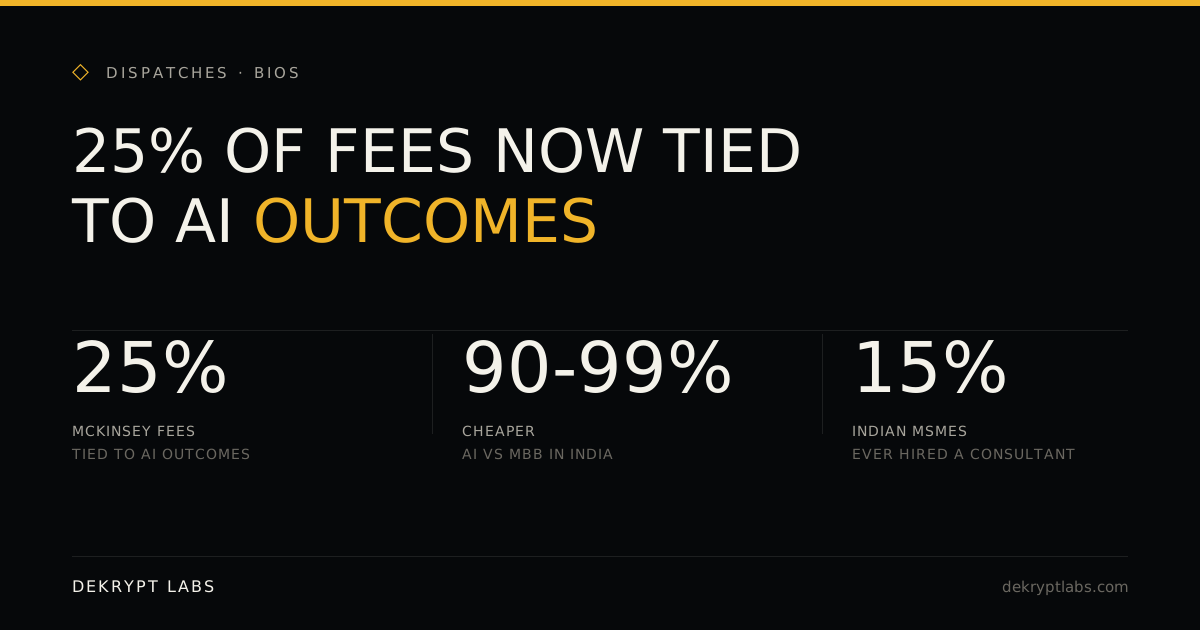
McKinsey now ties roughly 25% of its global fees to outcomes instead of hours billed. That's not a pricing experiment — it's an admission. The firm that invented the billable-hour report just conceded that AI does the work the hour used to measure.
The short version
- McKinsey ties ~25% of global fees to outcome-based pricing, not billable hours, per UK managing partner Michael Birshan.
- McKinsey's internal AI tool Lilli runs over 500,000 prompts a month, saving consultants up to 30% of knowledge-work time.
- BCG's AI-linked revenue share is projected to jump from ~20% in 2024 to ~40% by 2026.
- A standard MBB strategy engagement in India costs ₹50 lakh to ₹2 crore; an AI-powered equivalent runs ₹15,000 to ₹10 lakh — a 90-99% gap.
- Only 15% of Indian MSMEs have ever engaged a consulting firm, and cost is the reason most cite for staying out.
Why is McKinsey moving away from billable hours?
Because the hour stopped being a fair unit of value. When Lilli does a third of the research and drafting that used to take an analyst days, billing by the hour starts to look like billing for inefficiency, not output.
Bain has gone further. It invested in OpenAI's Deployment Company in May 2026 and extended a three-year joint-work arrangement with OpenAI. Bain's leadership expects AI- and tech-enabled work to climb from roughly 30% of consulting revenue today toward 50%.
Even the training pipeline has flipped. Around 150 former McKinsey, BCG, and Bain consultants have been contracted — per the Wall Street Journal — to train AI models on entry-level consulting tasks: the market sizing, the competitor scan, the first-draft deck. That's the layer these firms used to bill clients ₹1.5-3 lakh a day for.
How big is the price gap in India?
Big. A traditional MBB engagement runs ₹3-5 lakh per consultant per day; a Big 4 firm (Deloitte, EY, PwC, KPMG) runs ₹1.5-3 lakh per day. Minimum engagement size sits at ₹25-50 lakh for Big 4 work and closer to ₹1 crore at McKinsey.
| Service | Traditional cost (India) | AI-powered cost | Gap |
|---|---|---|---|
| Competitive analysis | ₹15L+ (bundled in engagement) | ₹15,000 – ₹50,000 | 90-99% |
| Market entry assessment | ₹25-50L | ₹50,000 – ₹2,00,000 | 93-97% |
| Due diligence (PE/VC) | ₹50L-1Cr | ₹2,00,000 – ₹5,00,000 | 96-97% |
| Digital strategy roadmap | ₹25-50L | ₹1,00,000 – ₹5,00,000 | 95-97% |
| Full engagement, 3-6 months | ₹50L-2Cr | ₹2,00,000 – ₹10,00,000 | 96-98% |
The reason the gap is this wide: 60-80% of a traditional consulting fee pays for research, data-gathering, and analysis — the exact layer AI now automates. The strategic judgment on top of it is a much smaller slice of the invoice than clients assume.
What does this mean for the 85% of Indian businesses who've never hired a consultant?
It means the constraint was never the question — it was the price of getting it answered. Only 15% of Indian MSMEs have ever engaged a consulting firm, and every survey on the topic names cost as the primary barrier, not need. A ₹1 crore minimum engagement was never built for a founder trying to decide whether to enter a new state market.
That gap is exactly why we're building BIOS — plain-English business questions in, a verified, confidence-scored intelligence report out, without a ₹1 crore floor. The McKinsey playbook of research-heavy, judgment-light work is precisely what's collapsing in price; BIOS is built for the businesses that playbook always priced out.
None of this means MBB firms disappear — Bain's OpenAI partnership and McKinsey's 500,000 monthly Lilli prompts suggest the opposite: they're re-arming, not retreating. What changes is who can afford to ask a serious strategic question in the first place. For more on how AI is restructuring intelligence work in India, see our dispatches and research.
The billable hour didn't just get cheaper. For the 85% of Indian businesses that were priced out of it entirely, it just became affordable for the first time.
Frequently Asked Questions
Why is McKinsey tying fees to AI outcomes instead of billable hours? Because AI tools like McKinsey's Lilli now handle up to 30% of the research and drafting work consultants used to bill hourly. Outcome-based pricing (~25% of global fees) better reflects value delivered when AI compresses the labor behind each hour billed.
How much cheaper is AI-powered consulting than McKinsey or Big 4 in India? AI-powered engagements in India typically cost ₹15,000 to ₹10 lakh, versus ₹50 lakh to ₹2 crore for a standard MBB or Big 4 strategy engagement — a 90-99% reduction, since 60-80% of traditional fees pay for research and analysis that AI now automates.
What percentage of Indian MSMEs have used a consulting firm? Only about 15% of Indian MSMEs have ever engaged a consulting firm. Surveys consistently cite cost, not lack of need, as the primary reason the other 85% have never bought strategic advisory work.
Is Bain or BCG actually losing revenue to AI? No — the opposite. BCG's AI-linked revenue is projected to grow from ~20% (2024) to ~40% (2026), and Bain expects AI/tech-enabled work to climb from ~30% toward 50% of its business, partly through a direct investment and multi-year partnership with OpenAI.
Abhishek Gupta is Co-Founder at Dekrypt Labs, building BIOS — a Business Intelligence Operating System for Indian businesses. dekryptlabs.com