McKinsey AI Disruption: Why BCG Is Winning, Not Losing
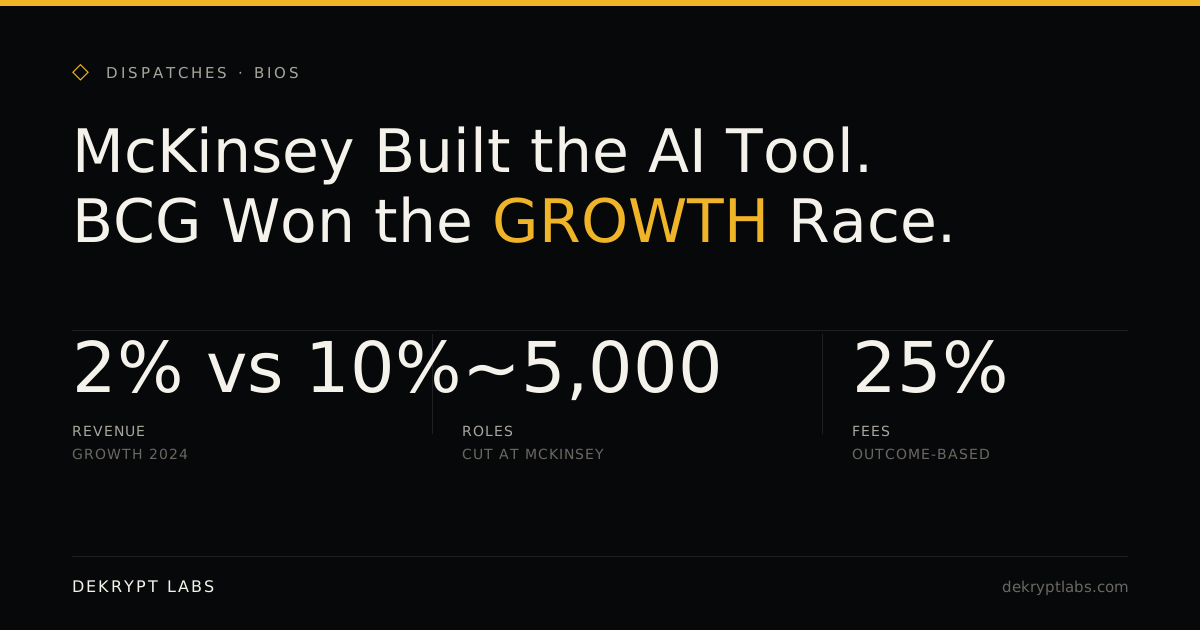
McKinsey built the AI tool everyone in consulting envies. It still lost the growth race to BCG by five times over.
In 2024, McKinsey's revenue grew 2%. BCG's grew 10%. At that gap, BCG is on pace to overtake McKinsey as the highest-grossing strategy firm by 2027 — a title McKinsey has held for decades. The headline story everyone's telling is "AI is killing McKinsey jobs." The actual story is narrower and more useful: McKinsey built the better AI product and is still losing share, because it never rebuilt how it sells the work.
The short version
- McKinsey grew revenue 2% in 2024 versus BCG's 10% — a five-times gap that puts BCG on track to overtake McKinsey by 2027.
- McKinsey has cut roughly 5,000 roles, close to 10% of its global headcount, in its largest reduction since 2008.
- McKinsey's internal AI assistant, Lilli, handles 500,000+ prompts a month and is used by roughly 70% of staff, saving consultants up to 30% of research time.
- Only 25% of McKinsey's fees are tied to outcomes instead of billable hours — the other 75% is still the old model, even with Lilli running underneath it.
- BCG's AI-linked work was ~20% of 2024 revenue and is projected to hit ~40% by 2026; Bain says AI/tech-enabled work is already ~30% of its business, headed toward 50%.
The Real Story Isn't McKinsey's Layoffs
Every recent headline about McKinsey frames this as an AI-replaces-analysts story: the firm has cut close to 5,000 roles, its steepest cut since the 2008 financial crisis, and commentators point straight at Lilli, the internal AI assistant, as the reason (Strat-Bridge).
That framing misses the more interesting number sitting right next to it. BCG isn't cutting nearly as aggressively, and it's still growing five times faster. If AI-driven efficiency alone explained the layoffs, the firm doing AI hardest — McKinsey, whose Lilli is the most publicly cited AI tool in consulting — should be pulling ahead, not falling behind on growth. It isn't. We've tracked a similar pattern in other AI-adoption stories in our dispatches — the firm with the flashiest AI tool is rarely the one that converts it into growth.
Why Is BCG Growing Five Times Faster Than McKinsey?
BCG sells AI work as new revenue — roughly 20% of 2024 revenue, headed toward 40% by 2026 — while McKinsey mostly uses AI internally to make its existing billable-hour model more efficient, and keeps the savings rather than converting them into new fee structures.
That's the mechanical difference. McKinsey's Lilli runs across more than 100,000 internal documents, aggregates the relevant five to seven sources, and points a consultant to the right expert in minutes instead of hours (Outsource Accelerator). It's a genuinely good tool. But a research assistant that makes an analyst faster doesn't change what the client is billed for — it just changes how the firm's margin looks internally. BCG, by contrast, packaged its AI capability as a sellable practice area and grew the top line with it.
| Metric | McKinsey | BCG |
|---|---|---|
| 2024 revenue growth | 2% | 10% |
| Recent headcount cut | ~5,000 roles (~10%) | Not comparable at this scale |
| AI-tied revenue share | 25% of fees outcome-based | ~20% (2024) → ~40% (2026 proj.) |
| Public AI product | Lilli (internal only) | Sold as client-facing AI practice |
Sources: Strat-Bridge, AI Weekly / WSJ summary.
McKinsey Built the Better AI Tool. It's Still Losing Ground.
This is the counterintuitive part. Lilli is the tool every consulting-AI listicle references. Adoption inside the firm is high — around 70% of employees, by McKinsey's own account — and the time savings are real, not marketing fluff: up to 30% off research work, according to the Wall Street Journal's reporting on the firm's internal figures (AI Weekly).
None of that shows up in McKinsey's growth rate, because only 25% of its fees have moved to outcome-based pricing. The other 75% is still sold by the hour, and an hour saved by AI under an hourly-billing model is an hour of revenue the firm has to find somewhere else — usually by cutting staff to protect margin. Bain is following a similar arc, with AI and tech-enabled work already close to 30% of its business and climbing toward half (AI Weekly). The firms converting AI efficiency into new revenue lines are growing. The firm converting it into internal savings is shrinking its headcount to hold the line.
What This Means If You're the One Asking the Question
Strip away the McKinsey-versus-BCG rivalry and there's a plainer fact underneath: every number above describes what happens inside a multibillion-dollar advisory firm, not what a business gets when it actually needs an answer. Whichever of the two you hire, you're still buying a multi-week engagement, a team of analysts, and a bill measured in tens of thousands of dollars — AI tooling on the vendor's side hasn't changed that math for the client yet.
That gap between "the firm got more efficient" and "the client got a faster, cheaper answer" is the one worth watching. It's also the specific problem BIOS is built against: a plain-English business question going straight to a verified, confidence-scored report, without a McKinsey or BCG engagement letter in between. More on how that intelligence layer works is in our research notes.
Who Actually Wins the Consulting AI Race
The honest answer, based on the numbers above, is: neither firm has fully solved it yet. McKinsey has the more advanced internal AI product and the worse growth rate. BCG has the better revenue trajectory and a less-publicized AI stack. Both are still charging enterprise clients enterprise-consulting prices for work that AI has partially automated on the vendor's side. The firm — or the product — that actually passes that efficiency through to the buyer, rather than keeping it as margin, is the one that changes the category. Neither MBB firm has done that yet.
Frequently Asked Questions
Is AI actually replacing McKinsey consultants? Partially, and indirectly. McKinsey has cut roughly 5,000 roles as AI tools like Lilli reduce research and analysis time, but the firm still bills by the hour for 75% of its work — so the job cuts protect margin more than they reflect direct AI-for-human replacement.
Why is BCG growing faster than McKinsey despite McKinsey's AI investment? BCG sold its AI capability as new client-facing work, reaching roughly 20% of 2024 revenue and heading toward 40% by 2026. McKinsey mostly used AI to speed up its existing billable-hour model, which shows up as internal savings, not revenue growth.
What percentage of McKinsey's fees are outcome-based instead of hourly? About 25%, according to Wall Street Journal reporting on McKinsey's internal figures from late 2025. The remaining 75% is still billed on the traditional hourly consulting model, even as AI tools cut the hours required to do the work.
Will BCG really overtake McKinsey by 2027? At the current growth rates — McKinsey's 2% versus BCG's 10% in 2024 — BCG is on pace to pass McKinsey in revenue by 2027. That trajectory could shift if either firm changes its pricing model or growth rate before then.
Abhishek Gupta is Co-Founder at Dekrypt Labs, building BIOS — a Business Intelligence Operating System for Indian businesses. dekryptlabs.com