The Business Intelligence Gap Hurting Indian MSMEs
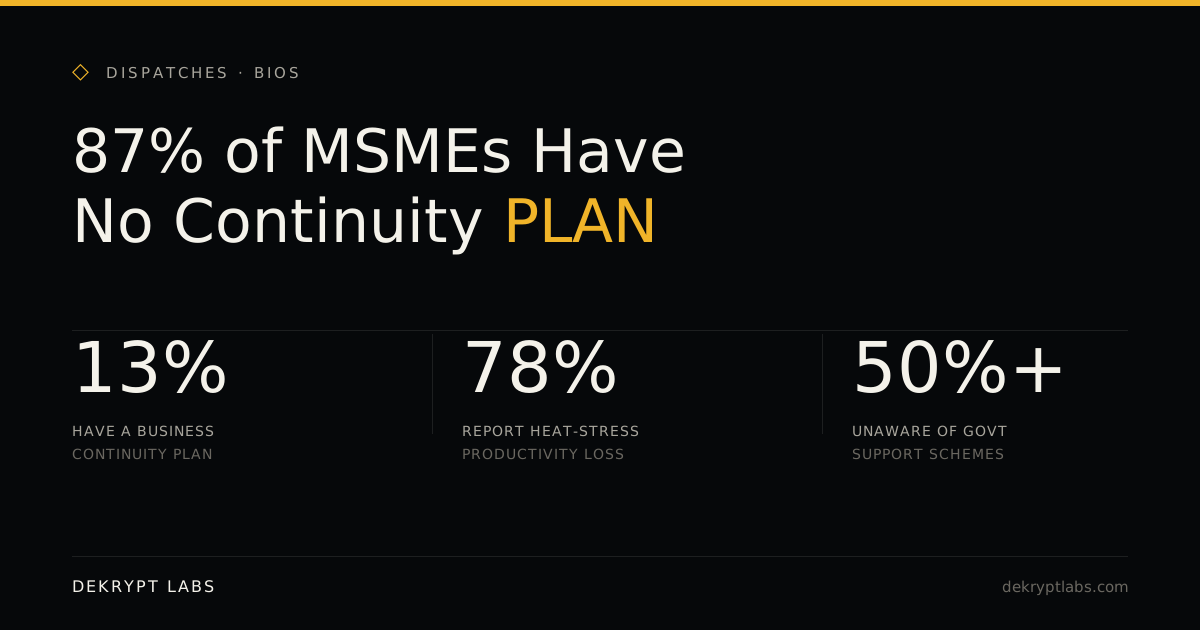
Only 13% of the 310 manufacturing MSMEs that WRI India surveyed across Chennai, Coimbatore, and Surat have a business continuity plan. Seventy-eight percent already report lost worker productivity from heat stress — not as a future risk, but right now, this operating year. That gap between exposure and preparedness isn't a climate story. It's a business intelligence gap MSMEs have been living with for years, and it costs more every monsoon it goes unfixed.
The WRI India report, published July 13, 2026 and led by Bhawna Ahuja, Program Manager for WRI India's Climate Resilience Practice, surveyed textile and auto-component units — sectors that run on tight margins and thin cash buffers. The headline numbers aren't about weather. They're about what these businesses don't know about their own exposure.
The short version
- WRI India surveyed 310 manufacturing MSMEs in Chennai, Coimbatore, and Surat (textile and auto-component sectors), published July 13, 2026.
- Only 13% of surveyed MSMEs have a business continuity plan; just 21% have access to emergency funds.
- 78% report reduced worker productivity from heat stress; over 50% saw rising absenteeism in high-heat periods.
- Among flood-affected units, 90% reported operational disruption, 75% faced temporary closures, and 67% lost revenue.
- Over 50% of MSMEs are unaware of government support schemes that exist for them; of those who do know, 30% found the application process too complex to use.
Why don't MSMEs already know their own risk?
Because nobody hands a 40-person auto-component unit a McKinsey deck. Large enterprises pay consultants or run in-house risk teams to map exposure, model downside, and track policy. A manufacturing MSME in Coimbatore has none of that — it has a promoter making decisions off what happened last year and what a supplier mentioned last week.
That's not a training problem. WRI India found 81% of surveyed MSMEs report "moderate awareness" of climate change in general — the concern is there. What's missing is the translation from general awareness to a specific, answerable question: what is my flood exposure, what schemes am I eligible for, and what does a continuity plan for my unit actually look like? Nobody in the business has the time, the data access, or the analytical muscle to answer that on their own.
What does the scheme-awareness number actually mean?
More than half of surveyed MSMEs don't know which government support schemes apply to their business, and of the minority who do know, 30% gave up because the application process was too complex. That's not indifference — it's a business intelligence gap: relevant information exists, but no one converted it into an answer a specific business could act on.
| Preparedness gap | Share of surveyed MSMEs |
|---|---|
| No business continuity plan | 87% |
| No access to emergency funds | 79% |
| Unaware of applicable government schemes | 50%+ |
| Aware of schemes but blocked by complexity | 30% (of the aware group) |
| No long-term retrofitting adopted | 81% |
Every row in that table is the same failure mode: a question ("am I covered," "am I eligible," "what should I actually do") that never got a verified, specific answer. Multiply 310 surveyed firms by India's roughly 6.3 crore MSMEs and the scale of unanswered questions is not a niche problem — it is the default state of Indian small business.
The flood numbers show what happens when the gap goes unaddressed
Among the MSMEs in the survey that were hit by floods, 90% reported operational disruption, 75% shut down temporarily, and 67% lost revenue outright. These aren't abstract risks materializing for the first time — flooding in Chennai and Coimbatore is a known, recurring event. The disruption rate is high precisely because preparedness was low going in: only 19% of surveyed MSMEs had adopted any long-term retrofitting measures before the event happened.
Compare that to how a well-resourced enterprise would handle the same exposure: a risk assessment before the monsoon, a mapped list of eligible relief and insurance schemes, a written continuity plan reviewed annually. None of that requires a McKinsey engagement — it requires someone converting public, available information (weather patterns, scheme eligibility rules, insurance product terms) into a specific, verified answer for one specific business. That is a solvable intelligence problem, not an unsolvable financial one, and it's a big part of why we're building BIOS — a Business Intelligence Operating System that turns exactly this kind of scattered, public information into a confidence-scored answer to a plain-English question, instead of leaving a promoter to guess.
What should an MSME actually do first?
Get a written answer to three questions before the next monsoon: what is this specific unit's flood and heat exposure, which government schemes does it currently qualify for, and what does a minimum viable continuity plan look like for its size. WRI India's data shows most MSMEs currently have none of these answers documented anywhere.
None of those three questions require expensive consulting. Flood exposure by pincode, scheme eligibility criteria, and continuity-plan templates are all publicly available — the gap is someone doing the work of matching public data to one specific business's situation, with a verifiable source behind every claim.
For more on how public data gaps compound into strategic blind spots for Indian businesses, see our earlier dispatch on competitive intelligence for Indian SMBs. For the broader research behind these posts, browse dekryptlabs.com/research.
Frequently Asked Questions
What percentage of Indian MSMEs have a business continuity plan? According to WRI India's July 2026 survey of 310 manufacturing MSMEs in Chennai, Coimbatore, and Surat, only 13% have a formal business continuity plan, and just 21% have access to emergency funds to respond to a disruption.
How many Indian MSMEs are unaware of government support schemes? The same WRI India survey found over 50% of surveyed MSMEs are unaware of applicable government support schemes. Among the minority who are aware, 30% still don't apply because they find the process too complex to navigate.
Why do floods cause so much disruption to MSMEs that already know about climate risk? Awareness isn't preparedness. WRI India found 81% of MSMEs report general climate awareness, yet 90% of flood-affected units still suffered operational disruption because that awareness was never converted into a specific plan, scheme application, or retrofit for their business.
What sectors and cities did the WRI India MSME survey cover? WRI India's "Resilience of Micro, Small and Medium Enterprises to Climate Risk" report surveyed 310 manufacturing units in the textile and auto-component sectors across Chennai, Coimbatore, and Surat, published July 13, 2026.
Abhishek Gupta is Co-Founder at Dekrypt Labs, building BIOS — a Business Intelligence Operating System for Indian businesses. dekryptlabs.com