NBFC Credit Risk: Bond Coupons Outpace the Repo Rate
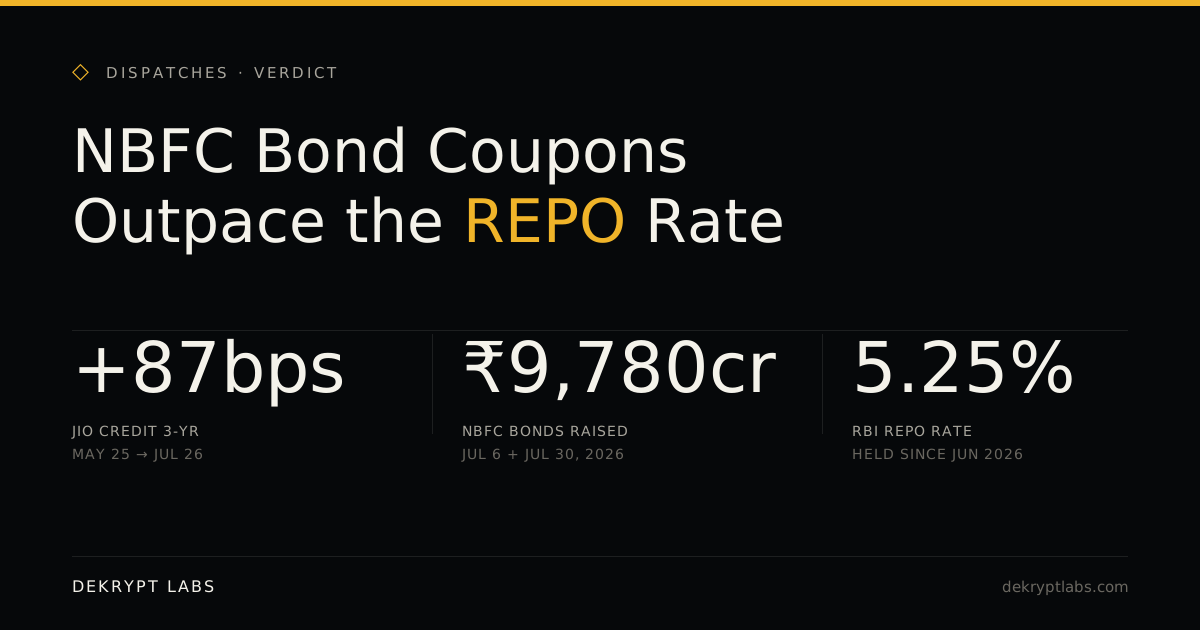
Jio Credit paid 7.08% for three-year money on May 27, 2025. On July 30, 2026, it paid 7.95% for the same tenor. That's an 87 basis-point jump in fourteen months — while the RBI's repo rate has sat flat at 5.25% since June 2026.
If your credit model still treats "cost of funds" as a single number pulled off last quarter's balance sheet, this is the week that number stopped being true.
The short version
- Jio Credit's three-year bond coupon rose from 7.08% (May 27, 2025) to 7.95% (July 30, 2026) — 87 basis points, with the repo rate unchanged.
- On July 30, 2026, Jio Credit, Hero Fincorp, Tata Projects and NIIF Infrastructure Finance placed ₹2,520 crore of bonds two trading days before the RBI's August MPC review.
- Three weeks earlier, on July 6, Tata Capital, Bajaj Housing Finance and Jio Credit raised ₹7,260 crore in a single session, with SIDBI lining up a ₹8,000 crore AAA-rated NCD right behind them.
- Coupons across the July 2026 issuances ranged 7.53%–8.15% for three- to five-year NBFC paper — a 228–290 bps spread over a repo rate most economists expect the RBI to hold at 5.25% this week.
- None of this shows up in a credit memo that models cost of funds as a repo-rate pass-through instead of a primary-market observation.
Why Is NBFC Bond Pricing Diverging From the Repo Rate?
Because bank funding to NBFCs carries a risk-weight premium the RBI imposed to slow shadow-bank leverage, so NBFCs increasingly price their debt against bond-market demand, not the policy rate. When that demand tightens even slightly, coupons move well before the repo rate does.
The RBI's Monetary Policy Committee meets this week — August 3–5, 2026 — and consensus, per Business Standard, is a hold at 5.25%, where the rate has stood since June. A quiet policy week is exactly when funding-cost divergence is easiest to miss, because the headline number gives no signal that anything moved.
What Did the July 2026 Bond Market Actually Show?
Two data points, three weeks apart, both reported by Business Standard:
| Date | Issuer | Amount | Tenor | Coupon/Yield |
|---|---|---|---|---|
| Jul 6, 2026 | Tata Capital | ₹2,750 cr | 3-yr (mat. Jul 2031) | 7.88% |
| Jul 6, 2026 | Tata Capital | ₹1,000 cr | mat. Jun 2029 | 8.15% |
| Jul 6, 2026 | Bajaj Housing Finance | ₹1,500 cr | mat. Sep 2029 | 7.53% |
| Jul 6, 2026 | Jio Credit | ₹965 cr | 3-yr | 7.78% |
| Jul 8, 2026 | SIDBI (NCD) | up to ₹8,000 cr | 3yr 3m 30d | AAA/Stable rated |
| Jul 30, 2026 | Jio Credit | ₹525 cr | 3-yr | 7.95% |
| Jul 30, 2026 | Jio Credit | ₹500 cr | 5-yr | 8.05% |
| Jul 30, 2026 | NIIF Infrastructure Finance | ₹550 cr | 3-yr | 7.88% |
Read down the Jio Credit rows alone: 7.78% on July 6, then 7.95% for the same three-year tenor on July 30 — a 17 bps move inside 24 days, from the same issuer, in the same rate environment. That's not noise. That's the primary market repricing risk faster than the policy rate can register it, per the same Business Standard reporting on the July 30 placements.
How Much Has Jio Credit's Cost of Debt Actually Moved?
Roughly 87 basis points on matched three-year tenor — from 7.08% at its May 27, 2025 issuance to 7.95% on July 30, 2026. Over the same period, the RBI's repo rate has been cut, held, and is expected to hold again this week at 5.25%. The two lines are no longer moving together.
That gap matters more than the absolute coupon. A credit committee sizing a lending book against "current cost of funds plus spread" is implicitly assuming the two track each other. Fourteen months of data from one issuer says they don't, and three weeks of data from five issuers in July says the divergence is current, not historical.
What Should Underwriting Models Capture Instead of a Static Cost-of-Funds Number?
They should treat NBFC funding cost as a live primary-market variable — pulled from the most recent comparable-tenor issuance, not a quarterly average — because a 228–290 bps spread over policy rate compresses net interest margin well before a rate cut or hike ever reaches a P&L line.
This is precisely the layer that breaks in a manual underwriting process: pulling the latest NCD prints, matching tenor and rating, and re-running the spread against a borrower's book takes a credit analyst hours every time a coupon prints — and it prints roughly weekly right now. An underwriting proposal that cites a bond yield from three months ago isn't wrong on the day it's written; it's wrong by the time an investment committee reads it. We built Verdict around exactly this problem — sourced, current inputs feeding a defensible credit or investment recommendation instead of a stale assumption dressed up as diligence.
None of this means NBFC lending is broken. It means the cost side of the ledger is moving on its own schedule, independent of the number everyone is watching this week. Read more sourced dispatches like this one at dekryptlabs.com/dispatches, or see the underlying research approach at dekryptlabs.com/research. The MPC decision lands August 5. The bond market already told you where funding costs are heading.
Frequently Asked Questions
Why are NBFC bond coupons rising if the RBI is holding the repo rate? NBFC bonds price off investor demand in the primary market, not the policy rate directly. Basel-style risk-weight rules on bank lending to NBFCs pushed more funding through bonds, so coupons now reflect bond-market appetite and issuer-specific risk, which can move independently of, and faster than, the RBI's repo rate decisions.
What is the RBI's expected repo rate decision in August 2026? The Monetary Policy Committee met August 3–5, 2026, with consensus among economists polled by Reuters and reported by Business Standard pointing to a hold at 5.25%, the level in place since the RBI's June 2026 review, citing elevated inflation and global uncertainty.
How much did NBFCs raise through bonds in July 2026? Across two reported sessions, NBFCs and related issuers raised over ₹7,260 crore on July 6, 2026 (Tata Capital, Bajaj Housing Finance, Jio Credit) and ₹2,520 crore on July 30, 2026 (Jio Credit, Hero Fincorp, Tata Projects, NIIF Infrastructure Finance), with SIDBI separately inviting bids for an ₹8,000 crore NCD issue on July 8.
Why does NBFC funding cost matter for credit underwriting? Funding cost sets the floor for what an NBFC can lend at while preserving margin. When bond coupons rise 200+ basis points over the policy rate, as seen in July 2026, underwriting models using stale or repo-linked cost-of-funds assumptions will misprice risk and overstate achievable margins on new lending.
Abhishek Gupta is Co-Founder at Dekrypt Labs, building Verdict — AI-assisted underwriting and investment proposals. dekryptlabs.com