NBFC Securitisation Hits ₹60,000 Cr as Gold Loans Take Lead
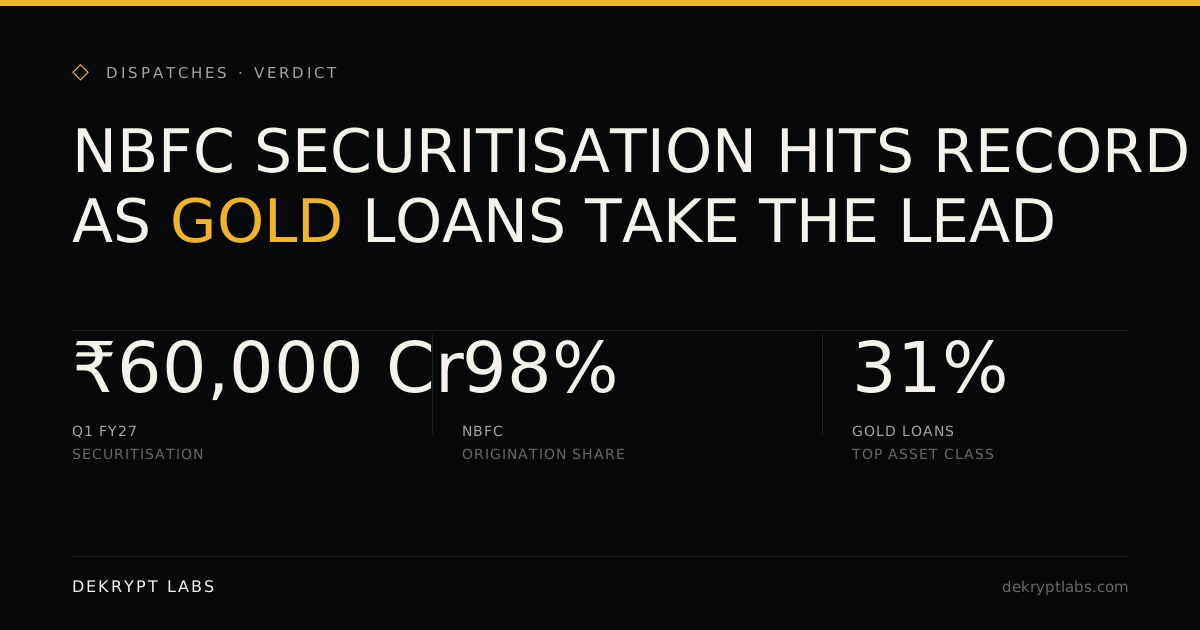
Non-bank lenders originated more than 98% of the ₹60,000 crore in loans India's NBFCs securitised between April and June — and for the first time, gold loans, not vehicle loans, made up the largest slice of that pool.
That's the headline from CRISIL Ratings' Q1 FY27 securitisation numbers, published July 7. It's the strongest first quarter the market has ever recorded, and the asset mix inside it says more about where NBFC risk is concentrating than the topline number does.
The short version
- Q1 FY27 (April–June 2026) securitisation issuances hit roughly ₹60,000 crore, up 22% year-on-year — a record for any first quarter, per CRISIL Ratings.
- NBFCs originated more than 98% of that volume. Bank-originated securitisation, which used to be a meaningful share even in peak quarters, is now close to a rounding error.
- Gold loans overtook vehicle loans as the largest securitised asset class: roughly 31% of volume versus vehicle loans' 26%.
- The dominant buyers are public-sector banks, drawn by near-zero historical credit losses on gold-backed paper and favorable risk-weight treatment.
- Gold-loan NBFCs are selling mostly through direct assignment — outright pool sales — rather than issuing pass-through certificates.
Why did gold loans overtake vehicle loans as the top securitised asset class?
Gold loans are fully collateralized, short-tenor, and have historically shown near-zero defaults even through credit stress cycles — collateral you can auction in days beats a repossessed vehicle you have to resell. That combination lets buyers assign gold-backed paper a lower risk weight than vehicle or unsecured loan pools, which is exactly what drew public-sector bank buyers to scale up purchases in Q1 FY27.
India's gold-loan NBFC segment — led by names like Muthoot Finance and Manappuram Finance, alongside a growing set of gold-loan-focused fintech lenders — has spent the last two years pushing loan-against-gold volumes hard, partly because RBI's revised gold-loan norms tightened LTV monitoring but didn't touch the underlying collateral economics that make the asset class attractive to securitise.
Why does 98% NBFC-only origination matter for investors?
A market where one type of originator supplies almost all the paper is a market with less diversity of underwriting standards behind the pools being sold. When banks originated a meaningful share of securitised assets, buyers had two different credit cultures to benchmark against. Today, they're mostly benchmarking NBFC underwriting against itself.
That's not automatically a red flag — several of India's top NBFCs run underwriting that's tighter than mid-tier banks. But it does mean due diligence on a securitised pool increasingly has to substitute for the market-structure diversity that used to do some of that work implicitly. A buyer evaluating a ₹500 crore gold-loan pool today is relying almost entirely on the originating NBFC's own loan-level data, collection history, and LTV discipline — there's no bank-originated comparable sitting next to it to sanity-check against.
What does the direct assignment route actually change for buyers?
| Structure | What the buyer gets | Where the risk sits |
|---|---|---|
| Direct assignment (DA) | Outright ownership of the underlying loan pool | Buyer bears first-loss risk directly; no tranching |
| Pass-through certificates (PTC) | A claim on cash flows via a trust structure | Risk is tranched; buyer picks a seniority level |
Direct assignment is faster to execute and cheaper to structure than a PTC, which is part of why gold-loan NBFCs are leaning on it. But it also means the buyer — usually a public-sector bank — is taking the pool as-is, with none of the tranching that would otherwise let them buy only the senior, lower-risk slice. The diligence burden on the buyer's side goes up exactly when the structure that would normally absorb some of that risk isn't there.
How should a lender or investor underwrite a securitised NBFC pool right now?
The CRISIL numbers describe a market getting more concentrated by originator type and more concentrated by asset class at the same time. That's the kind of shift that rewards buyers who go loan-level on diligence — vintage analysis, LTV drift, auction recovery rates on the specific NBFC's gold book — rather than buyers who underwrite to the asset class label alone. "Gold loan" is not a single risk profile once you're comparing pools from a dozen different originators with different appraisal standards.
This is the exact gap Verdict is built to close — turning a pool's loan tape and an originator's track record into a structured, sourced underwriting recommendation instead of a risk-weight shortcut. Read more on how we think about diligence at dekryptlabs.com/research.
Securitisation volumes will keep climbing as long as public-sector banks keep finding gold-backed paper cheaper to hold than to originate themselves. The number worth watching next quarter isn't the ₹60,000 crore topline — it's whether a second asset class emerges to challenge gold loans, or whether concentration keeps compounding in one direction.
Frequently Asked Questions
What is NBFC securitisation? NBFC securitisation is when a non-bank lender sells a pool of loans it originated — car loans, gold loans, personal loans — to another financial institution, converting future loan repayments into an upfront cash inflow the NBFC can use to originate more loans.
Why did gold loans become the top securitised asset class in Q1 FY27? Gold loans are fully collateralized and short-tenor with historically near-zero defaults, letting buyers apply favorable risk weights. That made them more attractive than vehicle loans to public-sector bank buyers, pushing gold loans to roughly 31% of Q1 FY27 securitisation volume.
What's the difference between direct assignment and pass-through certificates? Direct assignment transfers outright ownership of a loan pool to the buyer, who takes on the risk as-is. Pass-through certificates route cash flows through a trust and split the risk into tranches, letting buyers choose a specific seniority and risk level.
Why does 98% NBFC-only origination matter for due diligence? When almost all securitised paper comes from NBFCs rather than a mix of banks and NBFCs, buyers lose a natural benchmark for comparing underwriting quality. Diligence has to go loan-level — vintage, LTV drift, recovery rates — rather than relying on asset-class reputation alone.
Abhishek Gupta is Co-Founder at Dekrypt Labs, building Verdict — AI-assisted underwriting and investment proposals. dekryptlabs.com