NSE's SEBI Settlement: ₹714 Crore Clears the IPO Path
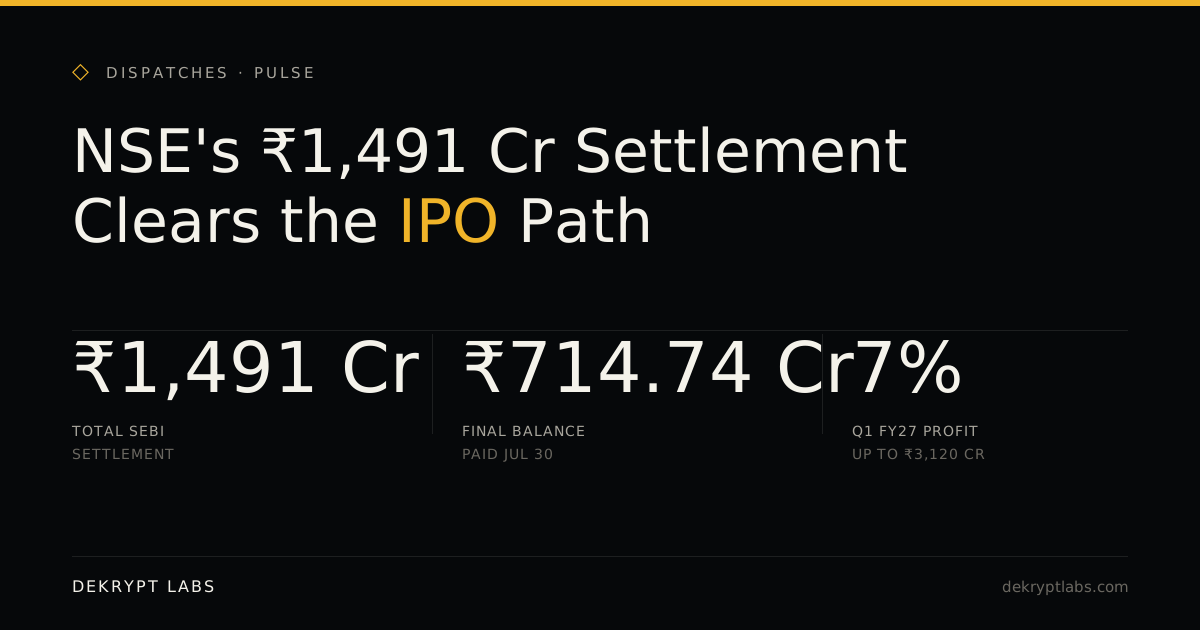
NSE just paid SEBI ₹714.74 crore. It's the final installment on the largest settlement in the regulator's history — and it clears the last real obstacle between India's biggest exchange and a listing that could value it near ₹6 lakh crore.
The exchange that runs India's price discovery just spent 15 years and ₹1,491.21 crore settling a case about who got to see prices first.
The short version
- NSE's board approved a ₹714.74 crore payment to SEBI on July 30, 2026 — the outstanding balance on a ₹1,491.21 crore settlement covering the colocation and dark fibre cases.
- The dispute traces back to 2010–2014, when select brokers allegedly got faster access to NSE's tick-by-tick data feed via colocation servers — a speed edge that let them react to prices before everyone else.
- NSE first proposed a ₹1,387.39 crore settlement in June 2025. SEBI revised the number upward to ₹1,491.21 crore in March 2026, after NSE had already deposited ₹776.47 crore toward it.
- Q1 FY27 consolidated profit still rose 7% year-on-year to ₹3,120 crore, even with the settlement provisioning running through the books.
- NSE filed its Draft Red Herring Prospectus with SEBI on June 17, 2026, at an indicative valuation of roughly ₹5–6 lakh crore ($60–65 billion), with a listing targeted before December 2026.
What Was the NSE Colocation Case About?
Between 2010 and 2014, brokers who paid for space in NSE's colocation facility could plug directly into its servers instead of connecting over the public internet. SEBI's allegation: some of those brokers got preferential, faster access to NSE's tick-by-tick data feed — a millisecond edge that compounds into real money in algorithmic trading. A parallel "dark fibre" case alleged similar preferential network connectivity for select trading members.
Why Did the Settlement Number Keep Rising?
Settlement math with SEBI isn't a single negotiation — it moves with each provisioning cycle. NSE's original June 2025 offer of ₹1,387.39 crore grew to ₹1,491.21 crore by March 2026.
The increase shows up directly in NSE's quarterly numbers. Q2 FY26 profit dropped to ₹2,098 crore after the exchange provisioned for the case, then Q1 FY27 profit recovered to ₹3,120 crore once most of that provisioning was absorbed. Read the quarter-over-quarter swing and you're watching the settlement negotiation play out in real time — a signal that lives in exchange filings, not headlines.
| Date | Event | Amount |
|---|---|---|
| June 20, 2025 | NSE's first settlement application | ₹1,387.39 crore |
| Nov 2025 | Q2 FY26 provisioning hits profit | Profit falls to ₹2,098 crore |
| March 13, 2026 | SEBI revises settlement upward | ₹1,491.21 crore |
| July 30, 2026 | NSE board approves final payment | ₹714.74 crore balance |
How Does This Clear NSE's IPO Path?
A settlement doesn't erase a regulatory case — it converts an open-ended liability into a fixed, known number. That's precisely what a listing prospectus needs. NSE's DRHP, filed June 17, 2026, is structured as an Offer for Sale of roughly ₹30,000 crore (about 6% dilution) — existing shareholders exit, NSE itself raises no fresh capital.
With the colocation and dark fibre overhang now quantified and largely paid down, the biggest disclosed contingent liability on NSE's balance sheet has a closing date instead of an open question mark. SEBI is reviewing the draft papers now; if the review runs its usual two to three months, NSE could list before December 2026 — India's largest-ever IPO, from the company that runs the exchange itself.
For anyone trading, covering, or holding a position ahead of a listing like this, the sequence above — application, revision, board approval, DRHP — is a string of separate exchange filings that only reads as one story once you line them up. That's the exact gap Pulse is built to close: it watches BSE and NSE filings continuously and flags the moment one connects to the next, instead of leaving you to notice the pattern after the fact.
Fifteen years is a long time to spend proving who saw a price a few milliseconds early. But the settlement's real significance isn't the number — it's that NSE, the institution that enforces disclosure discipline on every other listed company in India, just closed its own largest disclosure liability on the way to becoming one itself.
Frequently Asked Questions
What is the NSE colocation case? It's a SEBI investigation into whether certain brokers got preferential, faster access to NSE's tick-by-tick data feed through colocation servers between 2010 and 2014, giving them an unfair speed advantage in algorithmic trading over other market participants.
How much did NSE pay to settle with SEBI? NSE agreed to a total settlement of ₹1,491.21 crore for the colocation and dark fibre cases. After ₹776.47 crore already deposited, NSE's board approved the final ₹714.74 crore balance payment on July 30, 2026.
When is the NSE IPO expected? NSE filed its Draft Red Herring Prospectus with SEBI on June 17, 2026. If SEBI's review takes the typical two to three months, the IPO could launch around September–October 2026, with listing before December 2026.
What is NSE's expected IPO valuation? Based on unlisted market pricing of roughly ₹1,950–2,050 per share, NSE's indicative valuation sits near ₹5–6 lakh crore (about $60–65 billion), implying a price-to-earnings multiple in the high 50s to high 60s.
Abhishek Gupta is Co-Founder at Dekrypt Labs, building Pulse — real-time Indian markets intelligence. dekryptlabs.com
Related reading: SEBI's new disclosure timelines and deeper research on dekryptlabs.com/research.