Research Automation Reached CPG. Agencies Are Next
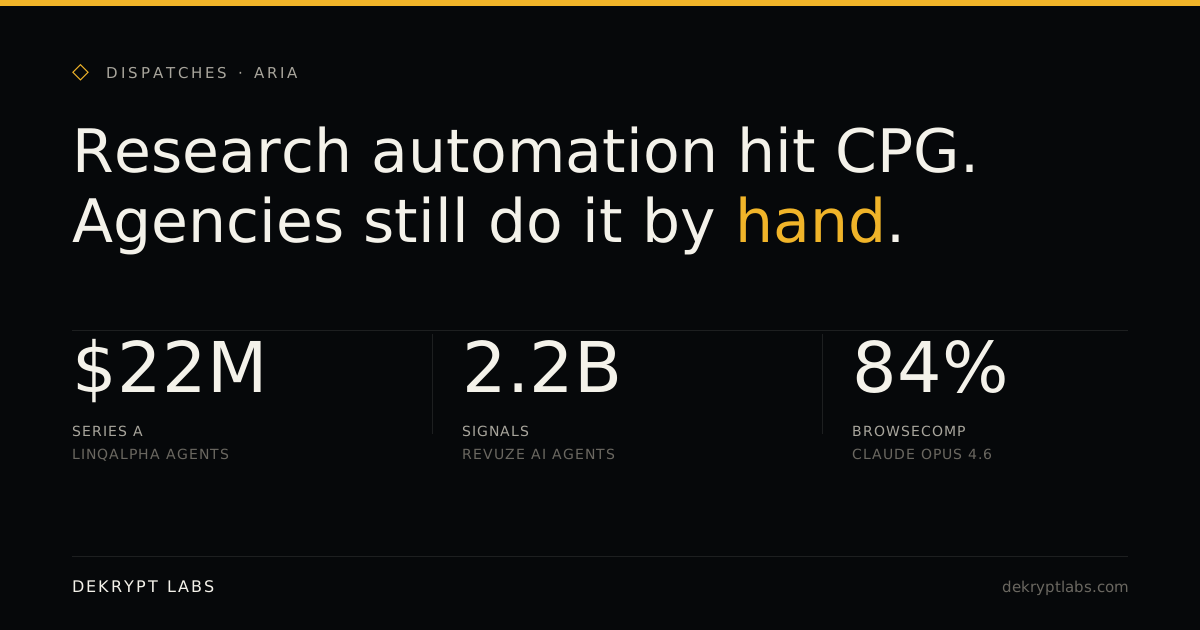
Revuze now runs autonomous agents over 2.2 billion consumer signals from 600-plus sources, tracking 100 million products across 2,000-plus categories. That's for CPG brands, not for the market-research agencies those same brands pay to interpret category data.
Research automation reached the intelligence layer in 2026. It has not reached the agency writing the report.
The short version
- Revuze launched autonomous agents and Model Context Protocol integration on June 24, 2026, putting 2.2 billion consumer signals directly in reach of CPG and retail brands, no agency required to query them.
- LinqAlpha, founded by ex-Goldman Sachs analysts and MIT computer science PhDs, raised $22 million in Series A funding on July 2, 2026, and its multi-agent research platform now serves 70-plus financial institutions, including Causeway Capital Management and Schonfeld Strategic Advisors.
- Claude Opus 4.6 scores 84% on BrowseComp, the benchmark for multi-round web research — high enough that an agent can now chase a citation trail a junior analyst used to spend a full day on.
- GetWhy and Market Logic partnered on June 4, 2026 to pipe raw consumer-interview transcripts straight into an enterprise insights platform, removing a manual synthesis step that used to sit between fieldwork and the deck.
- None of these four moves touched the actual research-agency production line — brief, proposal, questionnaire, fieldwork, analysis, deck — which most agencies still assemble by hand in 2026.
What changed in research automation in 2026?
Two categories adjacent to market research agentized their core workflow inside the last three weeks. CPG intelligence and financial research both moved from "AI-assisted analyst" to "agent runs the pipeline, analyst reviews the output."
Revuze's June 24 launch shipped three deployment modes at once: autonomous agents that run standing category-tracking jobs, direct MCP integration so a brand's internal LLM can query Revuze's data foundation without a dashboard, and Vee, a conversational assistant layered on top. The pitch is specific — general-purpose LLMs trained on open web data can't reliably answer a SKU-level question about, say, a Nielsen category code, because that taxonomy isn't public training data.
LinqAlpha built the same shape of product for public markets. Its $22 million Series A, anchored by AVP, Atinum Investment, and GFT Ventures, funds a multi-agent platform that reads filings, transcripts, and news for sell-side and buy-side research teams. The company already counts more than 70 financial institutions as customers, having raised $28.6 million in total since launch.
Why did CPG and finance automate first?
Both categories had two things market research agencies still lack: a closed, structured data foundation the agent can be grounded against, and a client willing to pay for a subscription instead of a project fee. Revuze had 2.2 billion tagged consumer signals already indexed. LinqAlpha had filings and transcripts that are machine-readable by regulation.
Market research runs on primary data instead — a survey fielded this month, a set of interviews conducted last week. There's no pre-existing index to ground an agent against; the data has to be generated before it can be analyzed, and that fieldwork step is where most of the manual hours still sit.
Where is the market-research agency workflow still manual?
| Stage | CPG intelligence (Revuze) | Financial research (LinqAlpha) | Market-research agency |
|---|---|---|---|
| Data foundation | 2.2B signals, pre-indexed | Filings + transcripts, machine-readable | Primary survey/interview data, generated per project |
| Query interface | Agent + MCP + Vee assistant | Multi-agent platform, API-native | Analyst manually reviewing raw responses |
| Deliverable | Live dashboard, standing job | Continuous research feed | One-off proposal → deck, rebuilt each brief |
| Client relationship | Subscription | Subscription | Per-project fee |
The gap in that last row is the actual business problem. An agency that could turn a subscription-style pipeline — brief in, structured deliverable set out — into its default mode of operation would be running the same shape of business Revuze and LinqAlpha just proved out in adjacent categories, three weeks apart.
What would an agentic research pipeline actually replace?
Not the fieldwork itself — someone still has to run the survey or conduct the interview. What's replaceable is everything downstream of raw responses: drafting the proposal against the brief, building the questionnaire, running the cross-tabs, writing the narrative, and assembling the client deck. That's the stretch where BrowseComp-grade research agents — Claude Opus 4.6 at 84%, GPT-5.4 Pro at 89.3% — are now strong enough to do a full first pass, with an analyst reviewing rather than authoring from scratch.
That's the specific gap ARIA is built against: a brief goes in, and a full research deliverable set — proposal, questionnaire, analysis, narrative, deck — comes out of an agent pipeline, the same way a brand's category question now goes straight into Revuze's agents instead of into an agency's inbox.
Nobody has shipped the agency-side equivalent of Revuze's June launch yet. Given how fast CPG and finance moved once the grounding data existed, that's less a question of if than of which agency's workflow gets rebuilt around an agent pipeline first — and which one keeps rebuilding the same deck by hand for the next brief.
Frequently Asked Questions
What is research automation in market research? Research automation means using AI agents to run parts of the research production line — questionnaire design, data analysis, narrative writing, deck assembly — that analysts currently do by hand for every client brief, rather than just using AI to speed up individual tasks.
Why did CPG and financial research automate before market-research agencies? Both had pre-existing, structured data foundations — Revuze's 2.2 billion indexed consumer signals, LinqAlpha's machine-readable filings — for agents to ground against. Market research relies on primary survey and interview data generated fresh for each project, so there's no standing index to query.
What is BrowseComp and why does it matter for research agents? BrowseComp is a benchmark measuring how well an AI model performs multi-round, "needle-in-a-haystack" web research requiring source synthesis. Claude Opus 4.6 scores 84% and GPT-5.4 Pro scores 89.3%, which is high enough for an agent to handle a first-pass literature or citation chase.
Does AI research automation replace fieldwork? No. Surveys still need to be fielded and interviews still need to be conducted by humans. What agent pipelines replace is the downstream work — proposal drafting, questionnaire design, cross-tab analysis, narrative writing, and deck assembly — that currently consumes agency hours after the raw data comes in.
Abhishek Gupta is Co-Founder at Dekrypt Labs, building ARIA — an AI research pipeline from brief to deck. dekryptlabs.com