SEBI Disclosure Timelines: 30 Minutes to 24 Hours
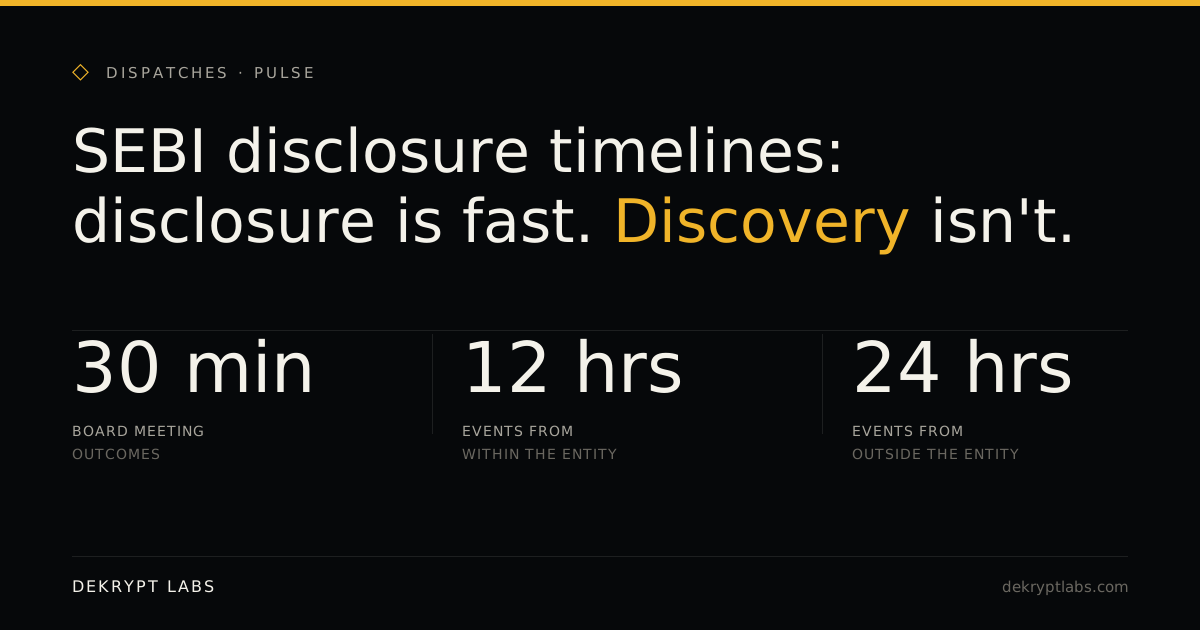
A listed company in India gets 30 minutes to tell the exchange what its board just decided. Not 30 minutes to draft a press release — 30 minutes from the moment the board meeting closes to the moment the filing must hit BSE and NSE. The SEBI disclosure timelines written into Regulation 30 of LODR are among the tightest anywhere, and they have been in force since June 14, 2023.
Here is the part almost nobody talks about: the regulation fixed the company's side of the information lag. The reader's side — the analyst, the trader, the IR team at a rival firm — is exactly where it was.
The short version
- Under Regulation 30(6) of SEBI LODR, board meeting outcomes must be disclosed within 30 minutes of the meeting closing.
- Events emanating from within the listed entity must be disclosed within 12 hours; events from outside within 24 hours.
- BSE carries roughly 5,595 listed companies and NSE about 2,629 — thousands of disclosures flow through exchange portals every trading day.
- Since December 1, 2024, the top 250 listed entities must confirm or deny a mainstream-media rumour within 24 hours of a material price movement.
- Disclosure got faster. Discovery — someone actually reading the filing in time to act — did not.
What are the SEBI disclosure timelines under Regulation 30?
Three windows apply. Board meeting outcomes: 30 minutes from closure. Events originating inside the company — a default, a resignation, a signed order: 12 hours. Events originating outside — a court ruling, a regulatory action: 24 hours. The clock starts when an officer of the company becomes aware through a credible channel.
| Trigger | Deadline | Example |
|---|---|---|
| Board meeting decision | 30 minutes from closure | Dividend, results, fundraise approval |
| Event from within the entity | 12 hours | CFO resignation, plant shutdown, large order win |
| Event from outside the entity | 24 hours | Court judgment, tax demand, regulator's order |
The 2023 amendment also cut the materiality threshold to hard numbers — 2% of turnover, 2% of net worth, or 5% of three-year average profit — so companies can no longer wave a "not material" flag at inconvenient news. The full framework is laid out in SEBI's April 2023 board memorandum.
Disclosure got faster. Discovery didn't.
Think about what a 30-minute deadline does to filing behaviour. Boards meet after market hours. Results season packs hundreds of meetings into the same evenings. The filings land at 7:43 pm, 9:12 pm, 11:58 pm — inside the window, outside anyone's attention span.
BSE lists about 5,595 companies and NSE about 2,629. On a routine day the announcement feeds run to thousands of PDFs: outcomes, disclosures under Regulation 30, corporate actions, insider trades under PIT, bulk and block deals. During results weeks the volume multiplies.
No human reads that feed. Most desks sample it — they watch their 40 or 80 names and accept blindness on the rest. Which means the market-moving filing from the mid-cap you don't cover, published at 11 pm on a Thursday, gets priced the next morning by whoever happened to be looking.
The regulation compressed publication lag to minutes. Reading lag is still measured in hours, sometimes days. That asymmetry is the actual edge left in Indian market information — not access, everyone has access — but speed of comprehension across the full breadth of the feed.
The rumour rule quietly made monitoring mandatory
Regulation 30(11) added a second-order obligation. Since June 1, 2024 for the top 100 listed entities, and December 1, 2024 for the top 250, a company must confirm, deny, or clarify a mainstream-media rumour about a specific impending event within 24 hours of a material price movement.
Read that from the company's side: to comply, an IR team must now watch its own stock price, watch mainstream media, connect the two, and get a board-level answer out — inside a day. That is a monitoring problem, not a drafting problem. Miss the price trigger and the company is non-compliant even if the eventual disclosure is perfect.
Read it from the investor's side and it is a gift: rumour-verification filings are among the highest-signal documents on the exchanges, because they force a yes/no on live M&A and fundraise speculation. They also arrive with zero fanfare, in the same undifferentiated feed as routine trading-window closures.
This is the class of problem Pulse is built for — reading every filing on both exchanges as it lands, at 11 pm or 6 am, and surfacing the ones that move prices before the market has finished its coffee.
Where the lag actually bites
Three recurring cases. First, after-hours board outcomes: a dividend cut or a surprise fundraise filed at night trades against yesterday's assumptions at the open. Second, the 12-hour internal-event window: resignations and order wins routinely surface post-close, and the gap between filing time and open is where early readers win. Third, peer disclosures: a raw-material supplier's plant shutdown is filed under the supplier's name, but the P&L impact belongs to every customer downstream — nobody's watchlist connects the two.
None of these require leaked information. Every one of them is public the moment it is filed. The research question worth asking is not "how do I get information first" but "how do I read everything that is already public, fast enough for it to matter."
SEBI has done its part of the job. The window between event and filing is now 30 minutes to 24 hours, enforced with hard materiality thresholds and delayed-disclosure explanations. The window between filing and comprehension belongs to whoever automates it. In a market of 5,500+ listed companies filing around the clock, the bottleneck has moved — permanently — from disclosure to attention.
Request access to Pulse → dekryptlabs.com/dispatches
Frequently Asked Questions
What is the SEBI disclosure timeline for board meeting outcomes? Thirty minutes. Under Regulation 30(6) of SEBI LODR, a listed company must disclose decisions taken at a board meeting within 30 minutes of the meeting's closure. This applies to outcomes like financial results, dividends, fundraises, and buybacks, and has been in force since June 14, 2023.
What is the difference between the 12-hour and 24-hour disclosure windows? The 12-hour window applies to events emanating from within the listed entity — resignations, defaults, signed contracts. The 24-hour window applies to events from outside — court rulings, regulatory orders, tax demands. Both clocks start when a company officer becomes aware through a credible, verifiable channel.
Which companies must verify market rumours under SEBI rules? The top 250 listed entities by market capitalisation. The obligation applied to the top 100 from June 1, 2024 and extended to the top 250 from December 1, 2024. They must confirm, deny, or clarify a specific mainstream-media rumour within 24 hours of a material price movement in their stock.
How many companies file disclosures on BSE and NSE? Roughly 5,595 companies are listed on BSE and about 2,629 on NSE as of 2025. Between board outcomes, Regulation 30 disclosures, insider-trading filings, and corporate actions, the two exchanges publish thousands of announcements on a typical trading day — far more during results season.
Abhishek Gupta is Co-Founder at Dekrypt Labs, building Pulse — real-time Indian markets intelligence. dekryptlabs.com