SEBI Reintroduces Open Market Share Buybacks
On April 1, 2025, SEBI cut the open market buyback route to zero. On August 1, 2026, it brings the same route back. Sixteen months, one regulator, a complete reversal — and the reason has nothing to do with the problem it originally cited.
The short version
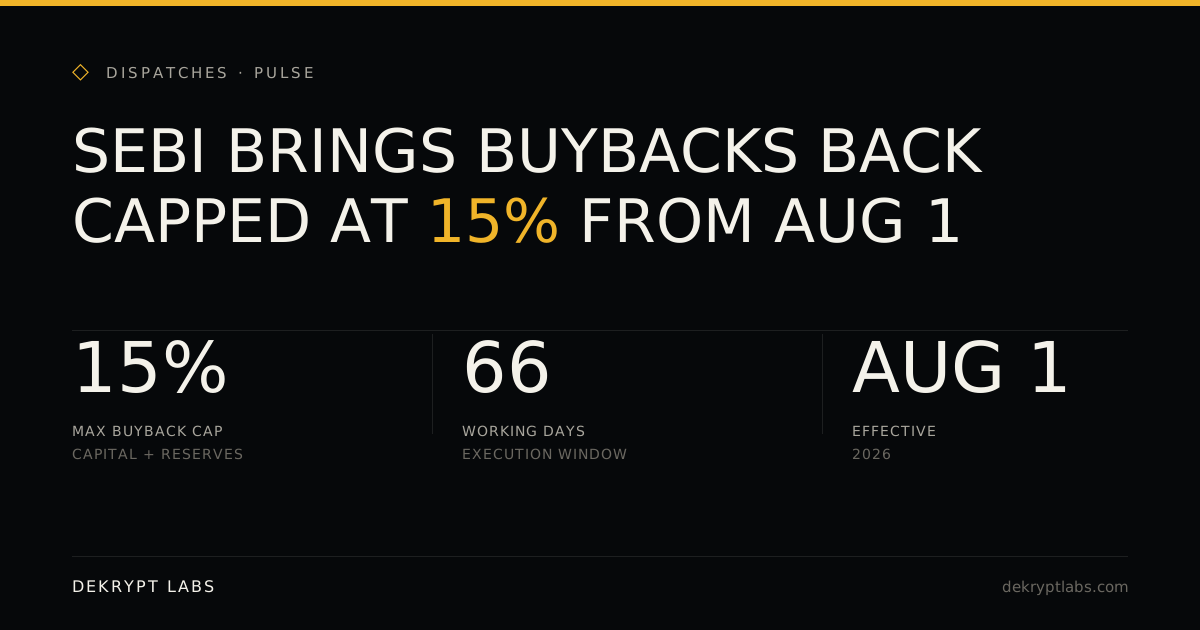
- SEBI's notification dated July 1, 2026 reopens open market buybacks via stock exchanges from August 1, 2026.
- The cap: less than 15% of paid-up capital and free reserves, on both standalone and consolidated financials.
- Execution must finish within 66 working days of the offer opening, and the offer must open within 4 working days of the public announcement.
- Engaging a merchant banker is now discretionary — it was mandatory under the tender-offer-only regime.
- Promoter shareholding is frozen at the ISIN level for the buyback window, and the rules explicitly bar announcements that would breach minimum public shareholding norms.
Why did SEBI kill this route in the first place?
SEBI didn't ban open market buybacks overnight. It throttled the cap from 15% to 10% in April 2023, to 5% in April 2024, and to zero on April 1, 2025 — a three-year phase-out. Then-chairperson Madhabi Puri Buch called the mechanism "vulnerable to favouritism."
The specific complaint: exchange-based buybacks execute on price-time priority, the same rule that governs every other order on NSE and BSE. Institutional desks and algorithmic traders queue faster than retail shareholders. SEBI's own read was that the people the buyback was supposed to protect were the ones losing the auction for it.
What actually changed between the ban and the reversal?
Not the price-time priority mechanism — that's unchanged in the new rules. What changed is tax. Under the old regime, buyback proceeds were taxed in the company's hands, and the burden effectively fell on shareholders who didn't even tender their shares. A change to the Income Tax Act now taxes buyback proceeds as capital gains for the shareholder who actually sells — the same treatment as a normal market sale.
SEBI's board approved the reintroduction on June 19, 2026, roughly ten weeks after that tax alignment took hold. The regulator's stated reasoning, per its own notification, is "flexibility, execution efficiency, and capital allocation options" — company-side language. The retail-versus-institution execution gap that justified killing the route in 2022 isn't addressed anywhere in the new framework.
Does the 66-working-day window fix the retail disadvantage?
No — it changes how fast a buyback finishes, not who gets filled first inside it. The tender-offer route, which became mandatory during the ban, guarantees every shareholder pro-rata access. The open market route reintroduces the same queue-based execution SEBI spent three years dismantling.
What should a company weighing this actually check?
| Route | Retail access | Merchant banker | Typical timeline |
|---|---|---|---|
| Tender offer (2025–26 mandatory route) | Pro-rata, guaranteed | Mandatory | Set by tender schedule |
| Open market (from Aug 1, 2026) | Price-time priority, not guaranteed | Discretionary | ≤66 working days from opening |
For a company sitting on surplus cash and wanting to support its stock price without the full tender-offer machinery, the open market route is materially cheaper to run — no mandatory merchant banker, faster to open, faster to close. For a retail shareholder deciding whether to tender, the calculus hasn't moved: the exchange queue still rewards speed and size.
Corporate action filings like this are exactly where the lag hurts. A 15% buyback cap or a promoter's frozen ISIN doesn't show up as breaking news — it shows up as a line in an exchange disclosure, and by the time it's summarized into a headline, institutional desks have already priced it in. That's the specific gap Pulse is built to close: it watches BSE and NSE filings as they post, not after someone writes them up.
Frequently Asked Questions
When does SEBI's open market buyback route reopen? August 1, 2026, per SEBI's notification dated July 1, 2026. The regulator's board approved the reintroduction on June 19, 2026. Companies can start using the exchange-based route for buybacks from that date onward, subject to the new 15% cap.
What is the buyback cap under the new SEBI rules? Companies can buy back less than 15% of their paid-up capital and free reserves, calculated on both standalone and consolidated financial statements. This replaces the zero cap that had been in effect since April 1, 2025, when SEBI fully phased out the open market route.
Why did SEBI ban open market buybacks in 2025 only to bring them back in 2026? The 2022–2025 phase-out targeted price-time priority favoring institutional and algorithmic traders over retail shareholders. The 2026 reversal is driven by a tax change — buyback proceeds are now taxed as shareholder capital gains, not a company-level tax — not by a fix to the original execution-fairness concern.
Is a merchant banker required for open market buybacks under the new rules? No. Engaging a merchant banker is discretionary for companies using the open market route from August 1, 2026. This is a deliberate loosening from the tender-offer regime, where a merchant banker's involvement was mandatory throughout the ban.
Abhishek Gupta is Co-Founder at Dekrypt Labs, building Pulse — real-time Indian markets intelligence. dekryptlabs.com