Competitive Intelligence for Indian SMBs: Public Data First
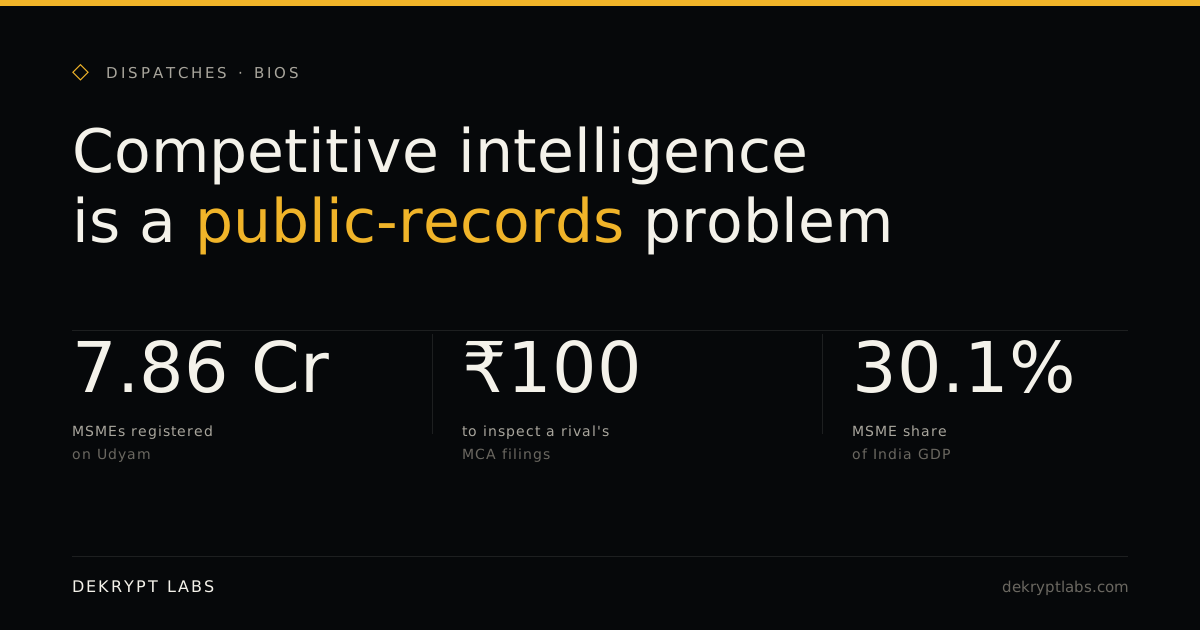
India has 7.86 crore enterprises registered on the Udyam portal and Udyam Assist Platform. Ask a hundred of their founders when they last read a competitor's balance sheet, and the honest answer is almost always never.
Here is the part that should sting: for most Indian private companies, that balance sheet is a public document. Competitive intelligence in India is less a data problem than a retrieval problem — the filings exist, priced at roughly ₹100 per inspection, and nobody pulls them.
The short version
- Every company registered under the Companies Act, 2013 must file its financial statements (Form AOC-4) and annual return (Form MGT-7) with the Ministry of Corporate Affairs. "Private limited" does not mean the numbers are private.
- Section 399 of the Companies Act gives any person the right to inspect a company's filed documents through the MCA portal on payment of a fee — about ₹100 per company.
- Entire businesses — Tofler, Zauba Corp — were built on repackaging exactly this public MCA data. The raw source they resell is open to anyone.
- MSMEs contribute 30.1% of India's GDP and 45.73% of its exports, per the MSME ministry — yet the segment buys almost no formal market intelligence, because it is priced for enterprises.
- The constraint is hours, not access. Reading one AOC-4 takes an evening. Tracking ten competitors quarterly is a week of skilled work nobody in a 40-person company has.
Your competitor's financials are not private
The phrase "private limited" misleads founders every day. Privately held means the shares don't trade publicly. The statutory filings — revenue, profit, borrowings, charges on assets, shareholding, director changes — sit with the Registrar of Companies, and the law makes them inspectable.
That is not a loophole. It is the design. Disclosure to the registrar is the price of limited liability, and it has been since the Companies Act 1956; the 2013 Act carried the inspection right forward in Section 399.
The proof that this data has commercial value is that aggregators sell it back to you. Tofler and Zauba Corp built products on MCA records — cleaned, structured, subscription-priced. Useful services, but the underlying documents were never locked away.
So the first move in any Indian competitive analysis is unglamorous: pull the last three years of your rivals' AOC-4 filings. Revenue trajectory, margin structure, debt load, related-party transactions. It is the closest thing to reading their board pack.
What is competitive intelligence for an SMB?
Competitive intelligence is the routine collection and analysis of public information about rivals — filings, prices, hiring, trade data — turned into decisions about pricing, expansion, and product. For an Indian SMB it starts with statutory records: MCA filings, Udyam registrations, exchange disclosures, and customs shipment data.
Nothing in that definition requires a retainer. What the Big Three and the research majors actually sell to enterprises is synthesis and judgment layered on sources that are, in India's case, unusually open.
Five public sources, ranked by effort
| Source | What it tells you | Cost |
|---|---|---|
| MCA filings (AOC-4, MGT-7) | A private rival's revenue, margins, borrowings, shareholding | ~₹100 per company |
| Udyam directory | Registered units by sector, district, investment band | Free |
| BSE/NSE disclosures | Listed players' commentary on your exact market, capex plans | Free |
| Customs shipment data | Who imports what, from which supplier, at what declared value | Paid aggregators |
| Job postings | Expansion cities, new product lines, tech stack, before any announcement | Free |
Two habits multiply the value of that table. First, triangulate: a rival's MGT-7 shows a new institutional shareholder, their job posts show four Bengaluru sales openings, and a listed competitor's earnings call mentions price pressure in the same segment — three free signals that together read like a funded expansion. Second, schedule it: intelligence pulled once is trivia; pulled quarterly, it is a trendline.
The failure mode is treating this as a one-time exercise before a fundraise. The companies that get ambushed by a competitor's price cut usually had the warning sitting in a filing or a shipment record for months.
Why founders still fly blind
Because the arithmetic of attention is brutal. Reading one set of financials takes an evening. Ten competitors, four sources each, every quarter — that is a week of skilled analyst time per quarter, recurring. A 40-person company does not have that person, and at enterprise consulting prices it will not rent one.
This is the exact gap BIOS is built for: you ask a plain-English question — "how did my three largest competitors' margins move over the last two years, and what changed?" — and get back a verified, confidence-scored report drawn from sources like these, with the citations attached.
We wrote earlier about what happens when consulting firms automate their own research layer. The mirror image is more interesting: the 7.86 crore businesses that never could afford that research layer getting it for the first time. More of our working notes on this live in our research and past dispatches.
The asymmetry in Indian business has never really been information access. The filings are public, the fee is ₹100, and the law has said so since 1956. The asymmetry is that large companies industrialised the reading of public records and small ones never did. That is a solvable problem — and the firms that solve it first get to see their market the way only their biggest competitor currently does.
Frequently Asked Questions
Can I legally see a private limited company's financials in India? Yes. Every company registered under the Companies Act, 2013 must file financial statements (AOC-4) and an annual return (MGT-7) with the Ministry of Corporate Affairs. Section 399 lets any person inspect these filings through the MCA portal for a fee of about ₹100 per company.
What is the cheapest way to do competitive intelligence for an Indian SMB? Start with free and near-free public sources: MCA filings for private rivals' financials, the Udyam directory for sector and district-level registration data, BSE/NSE disclosures for listed competitors, and job postings for expansion signals. Pull them quarterly so you get trendlines, not snapshots.
Why don't more Indian SMBs use MCA filings for competitor analysis? Mostly time, not access. Reading and comparing filings across ten competitors every quarter takes days of skilled work, and formal research subscriptions are priced for enterprises. The data is public; the analyst hours to process it are what most 40-person companies lack.
See what BIOS can answer → dekryptlabs.com
Abhishek Gupta is Co-Founder at Dekrypt Labs, building BIOS — a Business Intelligence Operating System for Indian businesses. dekryptlabs.com