Enterprise AI Adoption in India: High Use, Low Verification
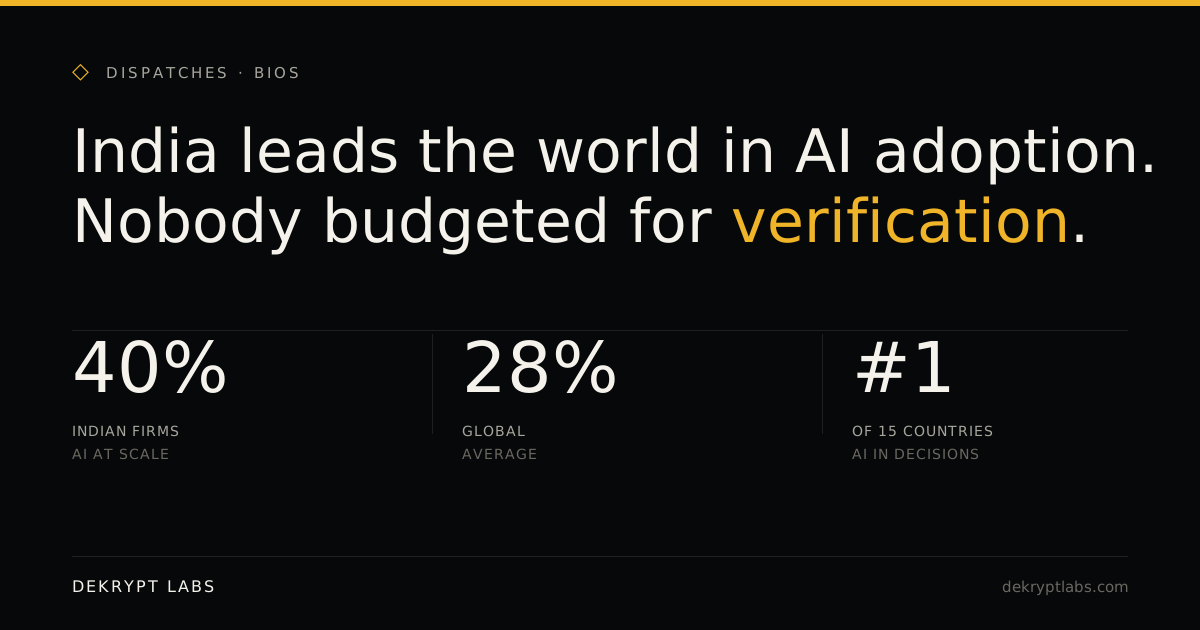
Deloitte asked 3,235 senior leaders across 24 countries how they use AI. No country puts it into strategic decisions more than India — first out of the 15 countries ranked in the 2026 State of AI in the Enterprise report.
Enterprise AI adoption in India is not an aspiration anymore; it is the operating default. Nearly 40% of Indian respondents report significant or full use of AI, against a global average of 28%. The uncomfortable part sits one layer down: the same survey says India rates its own expertise in the newest AI — agentic and generative — lower than its adoption numbers would suggest.
The short version
- Deloitte's 2026 State of AI in the Enterprise survey (3,235 senior leaders, 24 countries, fielded August–September 2025) found ~40% of Indian organisations report significant or full AI use versus 28% globally.
- India ranks first of the 15 countries compared on using AI in strategic decision-making.
- At-scale implementation in Indian firms is highest in product development (62%), strategy and operations (56%), and marketing and sales (55%).
- The same report finds India's self-reported expertise is strongest in traditional AI — and notably lower in agentic and physical AI, the categories now feeding decisions.
- In October 2025, Deloitte itself partially refunded a A$440,000 report to the Australian government after AI-fabricated citations were found in it. Adoption is not the hard part. Verification is.
India adopts AI faster than it audits it
The function-level numbers are the striking ones. This is no longer AI in the innovation lab; it is AI inside the workflows where money gets committed.
| Function | At-scale AI implementation (India) |
|---|---|
| Product development | 62% |
| Strategy and operations | 56% |
| Marketing and sales | 55% |
| Finance, HR | Lower — more "no plans" responses |
Strategy and operations at 56% deserves a second read. That is the function whose output is decisions — market entry, pricing, capacity, competitive response. More than half of surveyed Indian enterprises now run AI at scale in the exact place where a wrong number compounds fastest.
And the appetite is close to unanimous: 97% of respondents expect AI to raise productivity. Only one anxiety competes with the optimism — over 70% report high or very high concern about data security and privacy, which is why the top scaling investments are security and compliance controls (68%) and data storage and management (61%).
Notice what is missing from that investment list. Nobody is budgeting for checking whether the answers are true.
What does Deloitte's 2026 State of AI report say about India?
Indian enterprises lead global peers in at-scale AI adoption across most functions, with roughly 40% reporting significant or full use versus 28% worldwide, and rank first among 15 countries for AI in strategic decision-making. The same study finds Indian firms report lower expertise in agentic and generative AI than in traditional AI.
That last clause is the counterintuitive finding, and Deloitte prints it without much ceremony. The country using AI most aggressively for decisions self-reports the thinnest expertise in the AI generation actually making those decisions. Traditional AI — the forecasting and classification models Indian IT has run for a decade — is where the confidence lives. Agentic systems, the ones that research, reason, and recommend, are where it does not.
Adoption ran ahead of understanding. That is not a moral failing; it is what happens in every technology cycle. But it defines the risk profile precisely: the gap is not between firms that use AI and firms that don't. It is between firms that verify AI output and firms that forward it.
The A$440,000 warning shot
If you want to know what unverified AI output costs, the cleanest recent example implicates the surveyor itself.
In 2025, Deloitte Australia delivered a A$440,000 assurance review to the Department of Employment and Workplace Relations. A University of Sydney researcher, Chris Rudge, found it was studded with fabricated material: citations to academic papers that do not exist and an invented quote attributed to a Federal Court judgment. Deloitte acknowledged using Azure OpenAI in drafting, issued a corrected version, and refunded the final instalment.
Read that sequence carefully. The errors were not caught by the firm's review process, nor by the client who paid for the work. They were caught by one domain expert who happened to read closely. Every layer that was supposed to stand between a language model's confident fabrication and a government decision failed — at one of the most process-heavy professional services firms on earth.
Now transpose that to the Deloitte India findings. If 56% of Indian enterprises run AI at scale in strategy and operations, the Rudge role — the person who reads closely and checks the citation — mostly does not exist. He was an accident of the Australian story. He is not a system.
Verification is a layer, not a virtue
The fix is not slower adoption. India's lead is real and worth keeping — a decade of enterprise digitisation, cheap engineering talent, and boards that stopped debating whether AI matters. Winding that back to hand-checking every output would surrender the advantage.
The fix is structural: every AI-generated claim that feeds a decision needs a source, and every conclusion needs a confidence score that reflects how good that source is. A fabricated citation survives a vibe check; it does not survive a link back to a primary document that must actually resolve. This is the design principle behind BIOS — plain-English business questions answered with reports where each claim carries its citation and a confidence score, so the reader can see where the evidence is thick and where it thins out.
We have written before about what happens when consulting firms automate their own research layer; the Australian refund is that essay running in production. More of our working notes live in our research and past dispatches.
India spent twenty years building the world's back office and earned a reputation for process rigour under volume. The next reputation is up for grabs: the country that industrialised checking AI's work, or the country that ran unverified output into the most decisions the fastest. The Deloitte numbers say the second race has already started. The first one is still open.
Frequently Asked Questions
How widely is AI adopted by Indian enterprises in 2026? Deloitte's 2026 State of AI in the Enterprise survey found nearly 40% of Indian organisations report significant or full AI use, against a 28% global average. India ranks first among the 15 countries compared for AI use in strategic decision-making, with at-scale adoption highest in product development at 62%.
What is the biggest risk of using AI for business decisions? Unverified output. Language models fabricate citations, quotes, and figures with full confidence — Deloitte Australia partially refunded a A$440,000 government report in October 2025 after fabricated references were found in it. The risk concentrates wherever AI feeds decisions without a source-checking layer between the model and the decision-maker.
How do you verify AI-generated business research? Trace every material claim to a primary source that actually resolves — a filing, a dataset, a named document — and attach a confidence score reflecting source quality. Treat any statistic without a checkable origin as unverified. Tools built for verified intelligence, like BIOS, attach citations and confidence scores by default.
See what BIOS can answer → dekryptlabs.com
Abhishek Gupta is Co-Founder at Dekrypt Labs, building BIOS — a Business Intelligence Operating System for Indian businesses. dekryptlabs.com