Why India's GCCs Are Quietly Replacing McKinsey
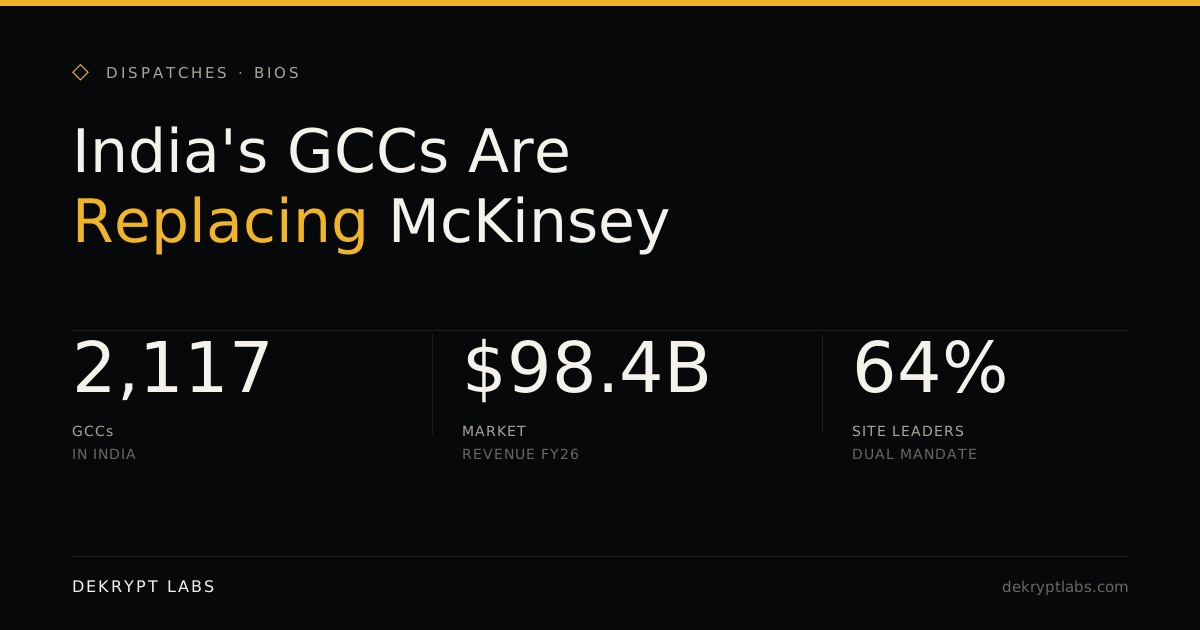
2,117. That's how many Global Capability Centres now operate in India — and 64% of their site leaders hold a "dual mandate" that didn't exist five years ago: run the site, and own a slice of global strategy.
India's GCCs used to be back-offices. The Nasscom-Zinnov numbers released this month say that era is closing, and the work moving in-house is exactly the work firms like McKinsey used to bill for.
The short version
- India now hosts 2,117 GCCs across 3,728 units, employing 2.36 million professionals and generating $98.4 billion in FY26 revenue — up 32% since FY2021.
- 506 of the Forbes Global 2000 now run a GCC out of India.
- 64% of site leaders hold a dual mandate — global functional ownership plus site leadership — a role that barely existed a decade ago.
- Nearly half of GCCs founded since FY2021 were built with AI as a core mandate, not a bolt-on; 250+ now run dedicated AI Centres of Excellence.
- The same period saw Indian advisory fees compress hard: assignments that once fetched ₹20–25 lakh are now closing at ₹10–12 lakh, per a Big 4 risk advisor quoted last year. Cheaper external analysis and cheaper internal analysis are the same trend, viewed from two buildings.
What changed inside India's GCCs?
A GCC used to mean a cost centre — IT support, back-office finance, offshore QA. Nasscom and Zinnov's "GCC Value Orbit" report describes something else: 75% of India's GCCs now have the profile to become "Portfolio or Transformation Hubs" within five years, running product decisions and strategic analysis, not just executing tickets from headquarters.
The dual-mandate number is the tell. When 64% of a GCC's site leaders also hold global functional ownership, the site isn't reporting into a strategy function abroad — it is the strategy function, sitting in Bengaluru or Pune instead of London or Boston.
Why would a company build this instead of hiring McKinsey?
Because the marginal cost of an answer has collapsed, and proximity to data now beats proximity to a partner's Rolodex. A GCC that already holds the company's sales data, support tickets, and market feeds can turn a "what's happening in our category" question around in days. An external firm has to onboard the context first, then bill for having onboarded it.
That's the same shift covered in our look at McKinsey's own AI numbers — the big three consultancies are automating their own analysts even as their clients build the equivalent capability in-house. Both sides are chasing the same $40-lakh line item.
Is this an AI story or a talent story?
Both, and they're the same story. Nearly half of GCCs opened since FY2021 were designed around AI from day one, and the AI hiring signal inside GCCs rose 1.5 percentage points in the last six months alone. The centres aren't just running dashboards faster — 250,000+ AI professionals now sit inside India's GCC base, more than the headcount of most global consultancies combined.
| Metric | Figure |
|---|---|
| Total GCCs in India | 2,117 |
| Operational units | 3,728 |
| Professionals employed | 2.36 million |
| FY26 market revenue | $98.4 billion |
| Growth since FY2021 | 32% |
| Site leaders with dual mandate | 64% |
| GCCs with high maturity | ~50% |
| Forbes Global 2000 with an India GCC | 506 |
Where does this leave the outside advisory model?
Not dead — narrower. External firms still win the work that needs an outside view, a regulatory relationship, or a name on a board deck. What's shrinking is the middle: the recurring "tell us what our competitors are doing" or "size this market for us" engagement that used to justify a standing retainer. That's precisely the work a GCC with its own data and its own AI stack can now do on a Tuesday instead of waiting three weeks for a deck.
The number worth sitting with isn't 2,117. It's 64%. A majority of GCC site leaders now own strategy, not just delivery. Five years of "AI as a core mandate" later, India's GCCs stopped being where global companies send their overflow work and started being where some of it originates. Track more dispatches like this one or dig into the underlying research behind the numbers above.
Frequently Asked Questions
What is a GCC and how many operate in India? A Global Capability Centre (GCC) is an in-house delivery and increasingly strategic unit that a global company runs from India instead of outsourcing. As of the Nasscom-Zinnov 2026 report, 2,117 GCCs operate across 3,728 units, employing 2.36 million people.
How much revenue do India's GCCs generate? India's GCC market generated $98.4 billion in FY26 revenue, up 32% since FY2021, according to the Nasscom-Zinnov "GCC Value Orbit" report published in July 2026.
Why are GCCs replacing consulting firms for strategy work? GCCs already hold their parent company's live data — sales, support, market feeds — so they can answer strategic questions in days without onboarding context an external firm would have to bill for first. 64% of GCC site leaders now hold global strategy mandates alongside site ownership.
How AI-focused are India's new GCCs? Nearly half of GCCs established since FY2021 were built with AI as a core mandate from inception, and over 250 now run dedicated AI Centres of Excellence, backed by a base of 250,000+ AI professionals.
Abhishek Gupta is Co-Founder at Dekrypt Labs, building BIOS — a Business Intelligence Operating System for Indian businesses. dekryptlabs.com